


Kanchenjunga North Base Camp Lodge Trek
Olangchung Gola Extension Option!
Nepal Himalayan Trekking
An amazing Himalayan trek through the diverse and sublimely beautiful Kanchenjunga region in Nepal’s exotic far east!
Majestic Kanchenjunga (8598 meters) is the world’s third highest mountain, surpassed only by Everest and K2. It is certainly one of the most spectacular massifs in the Himalayan range, rising majestically from the borders of Nepal and Sikkim (India). The region, inhabited by Tibetans and Limbus living in remote mountain villages, can be approached by both the Nepal and the Indian sides. Our trek along the Great Himalayan Trail to Kanchenjunga begins in Tumlingtar, in the Makalu region of Nepal.
Kanchenjunga is worshipped by the Tibetans in Sikkim as the home of their protector gods so isn’t climbed as much as the other Himalayan mountains. The first attempt to climb Kanchenjunga was in 1905 by Aleister Crowley, but the first successful attempt at climbing wasn’t until the British expedition of 1955. Located east of the great cleft of the Arun Salpa valley, the Kanchenjunga region receives the heaviest monsoon rains in all of the Himalaya. Its middle hills are lush, green and semi-tropical, full of seasonal flowers and foliage. Opened to trekking 1988, the Kanchenjunga region provides an opportunity to visit Rai and Limbu villages in the lush middle hills, and pristine forests, Himalayan glaciers and far-flung Tibetan villages higher up.
We start our journey in Tumlingtar, in the north-east of Nepal, gateway to the Arun Salpa valley leading to Tibet as well as the Everest, Makalu and Kanchenjunga regions. Trekking through a region of Rai villages, lush rainforests, patchworks of farmland and traditional mud-brick houses, we head north into an alpine world of birch, coniferous woodland and tumbling mountain streams. Beyond the tree line the landscape changes again, with the mighty Kanchenjunga massif presenting some of the most impressive high mountaiscenery on earth.
Our trek takes us northeast through remote Tibetan and Limbu villages. Kanchenjunga is the homeland of the Limbu people, who speak a dialect of Tibetan and follow a mixture of Buddhist, Hindi and animist beliefs. We trek the Kanchenjunga glacier to the spectacular north base camp at Pang Pema. After taking a day to hike to the spectacular Jammu viewpoint, we visit the Tibetan village of Ghunsa before crossing the Nango La (477m) to remote Olangchung Gola. Heading south through the village-laden middle hills of eastern Nepal, we finish the trek at Taplejung and Bhadrapur, finally flying back to Kathmandu …
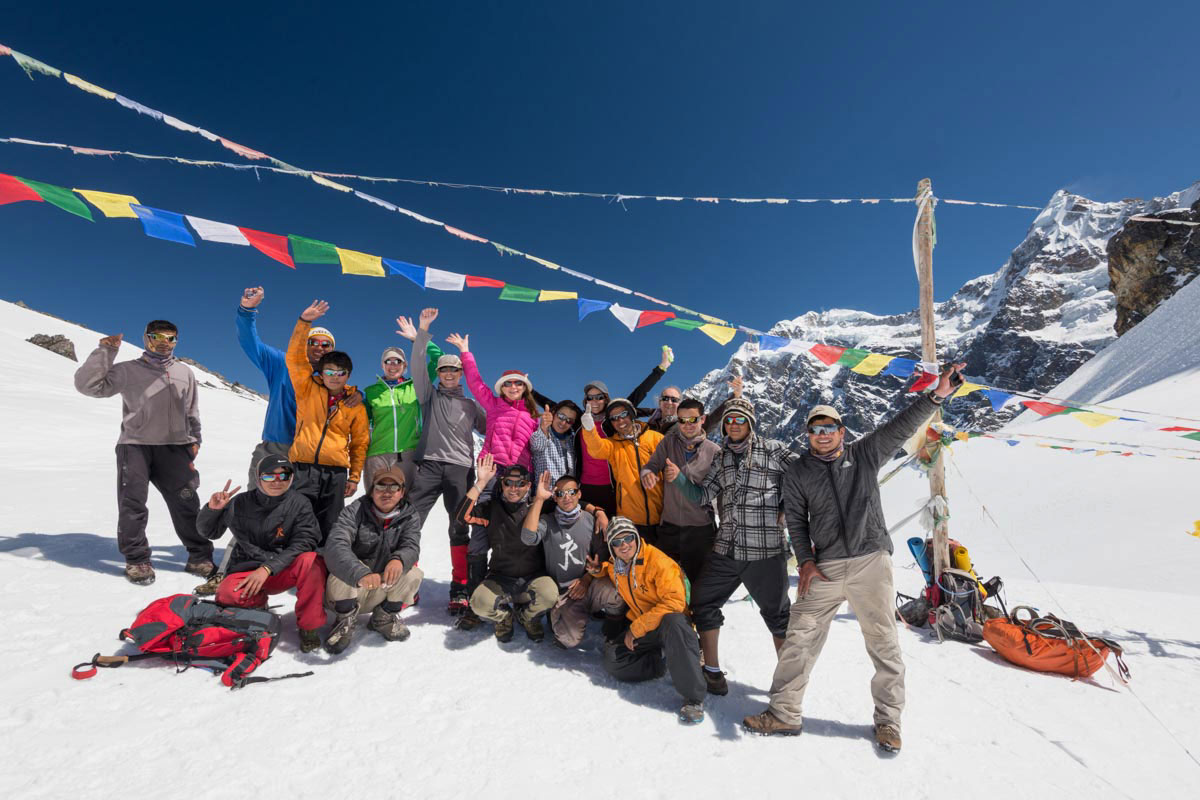
Trek
Kanchenjunga North Base Camp Lodge Trek – Nepal Himalayan Trekking
Day 1 – Arrive Kathmandu
Day 2 – Kathmandu | Optional World Heritage Sightseeing
Day 3 – Fly Taplejung (Suketar). Drive Sukethum (Japantar)
Day 4 – Trek Amjilosa
Day 5 – Trek Kyapra
Day 6 – Trek Phale
Day 7 – Trek Ghunsa
Day 8 – Trek Kambachen
Day 9 – Kambachen | Jannu Viewpoint Hike
Day 10 – Trek Lhonak
Day 11 – Trek Lhonak | Day Hike Pang Pema (Kanchenjunga North Base Camp)
Day 12 – Trek Kambachen
Day 13 – Trek Ghunsa
Day 14 – Trek Sukethum (Japantar)
Day 15 – Drive Ilam & Bhadrapur. Fly Kathmandu | Transfer Kathmandu Guest House
Day 16 – Trip Ends | Transfer TIA Airport
Kanchenjunga North Base Camp & Olangchung Gola Lodge Trek – Nepal Himalayan Trekking
Day 1 – Arrive Kathmandu
Day 2 – Kathmandu | Optional World Heritage Sightseeing
Day 3 – Fly Taplejung (Suketar). Drive Sukethum (Japantar)
Day 4 – Trek Amjilosa
Day 5 – Trek Kyapra
Day 6 – Trek Phale
Day 7 – Trek Ghunsa
Day 8 – Trek Kambachen
Day 9 – Kambachen | Jannu Viewpoint Hike
Day 10 – Trek Lhonak
Day 11 – Trek Lhonak | Day Hike Pang Pema (Kanchenjunga North Base Camp)
Day 12 – Trek Kambachen
Day 13 – Trek Ghunsa
Day 14 – Trek Kharka (High Camp)
Day 15 – Thasa Khola Camp (Cross Nango La)
Day 16 – Trek Olangchung Gola
Day 17 – Olangchung Gola
Day 18 – Trek Magawa
Day 19 – Trek Sukethum
Day 20 – Drive Ilam & Bhadrapur. Fly Kathmandu | Transfer Kathmandu Guest House
Day 21 – Trip Ends | Transfer TIA
Travel Advice
+ We strongly recommend keeping an extra day post-trek in Kathmandu in case of flight delays.
+ Travel insurance with helicopter evacuation required!
+ We recommend purchasing trip cancellation & travel insurance!
Nepal Modules
Nepal & Kathmandu Modules | Customize Your Trip!
Kim & Lhakpa’s Personally Guided Trips
Featured Journeys
Client Highlights & Reviews
Travelers’ Comments


Why Travel with Kamzang Journeys?
Why Trek with Us?
Kamzang Journeys Reviews!
Kamzang Journeys Reviews
Kim Bannister Photo Gallery | Trip & Trek Photos
Kim Bannister Photography
Kanchenjunga & Makalu Arun Lumba Sumba Trek Photos
Trek Photos 2015
Trek Photos 2011
Cafe Caravan & Dolpo Gallery
Dolpo Artist Tenzin Norbu creates wonderful Dolpo paintings, the prints (and some originals) available from our Cafe Caravan at Boudhanath Stupa.
Kamzang Journeys Products
Duffel bags, t-shirts, camp towels, buffs, handcrafted leather passport wallets, totes + bags, Himalayan textile pillow covers + more available in Kathmandu!
Kamzang Journeys Products
Kamzang Design Etsy Shop (On-Line)
Many of these handcrafted products designed by Kim and local craftspeople are available in Kathmandu, including much of the tribal silver collection …
Kamzang Design Etsy Shop
Client Highlights & Reviews
Travelers’ Comments
Private Trips & Customized Journeys
We’d love to customize a private trip or extension for you according to your dates. We can customize your journey to include more days in the Kathmandu Valley, Chitwan or Bardia National Park, Pokhara, Bhutan, Tibet or elsewhere. Inquire for helicopter tours and travel options!
Itinerary
Kanchenjunga North Base Camp & Olangchung Gola – Nepal Himalayan Trekking
Day 1 – Arrive Kathmandu 1340m (4395′) | Transfer Kathmandu Guest House
Welcome to Nepal! You will be met at Tribhuvan International Airport by a representative from Kamzang Journeys or Khumbu Adventures (our partners in Kathmandu) Doma, Lhakpa and Nuru Sherpa). Look for a sign with your name on it as you leave the arrival area. We strongly suggest purchasing a NTC (Nepal Telecom) SIM card as you leave the airport if you have an unlocked phone. It’s very useful for data in the remote regions of Nepal. We will transfer you to the Kathmandu Guest House (or see Great Stays tab for luxury, boutique, and other hotel options in the Kathmandu Valley) where your room has been booked for you. Drink plenty of water to hydrate after your flight, and enjoy your first evening in Kathmandu …
We’ll need your travel medical insurance, a copy of your passport and Nepali visa, and one (or more) visa-sized photos (inquire if we need for your trek); please have them ready to give to Lhakpa, Doma or Nuru. And please ask if you need your gear checked, or have shopping or sightseeing questions!
Thamel is a myriad of shops of all imaginable varieties, bakeries, cafes, restaurants, bars, hotels, spas, climbing walls, colorful banners and signs, and eccentrically clad backpackers. Enjoy dinner at Roadhouse Cafe, New Orleans, Yin & Yang, Third Eye, or one of Thamel’s other restaurants … (B)
Day 2 – Kathmandu
Enjoy a free day exploring Kathmandu’s many World Heritage sites or embark on a tour of the beautiful Kathmandu valley, surrounded by Himalayan snow peaks (See Kathmandu Valley Tours for optional tours with a qualified guide, car, and entrance fees included). Or just relax at the hotel, visit the spa, have a massage, wander Kathmandu’s fascinating streets, pop into neighborhood Hindu temples and Newari-styled courtyards, join in on koras of the Buddhist temples. (B)
Cafe Caravan & Dolpo Gallery
Dolpo Artist Tenzin Norbu creates wonderful Dolpo paintings, the prints (and some originals) are available from our Cafe Caravan at Boudhanath Stupa, housed in one of Boudha’s original historic buildings, decorated in a bright, Tibetan style and overlooking the magnificent stupa!
Sightseeing in Kathmandu
Nuru Wangdi Sherpa (Khumbu Adventures & Café Caravan) has his Kathmandu guide license and a large SUV vehicle, and can arrange any sightseeing you might want to do in Kathmandu and the Kathmandu valley. He is often available for guiding your excursions as well. Mobile + WhatsApp: +977 9803633783 (WhatsApp)
Massage in Kathmandu (Ramji of Relieving Hands)
Ramji is a blind masseur trained by Seeing Hands in Kathmandu, who now offers wonderful at home (or hotel) massages, with his own massage table and oil. He is truly a master masseur, a real healer and VERY highly recommended. His prices are extremely reasonable. Let us know if you want help to arrange a massage.
Relieving Hands by Ramji
Kathmandu | World Heritage Sightseeing Tours – Pashupatinath, Boudhanath, Durbar Square & Swayambunath
Kathmandu is filled with World Heritage sites and sacred destinations, crowded with traditional neighborhoods and colorful festivals. Spend a few days exploring Nepal’s exotic capital and the history-laden Kathmandu valley. We can arrange sightseeing guides and vehicles as required. See Kathmandu Heritage & Happenings for more details.
We recommend beginning with Pashupatinath in the early morning and moving on to Boudhanath mid-morning. Hindu Pashupatinath on the sacred Bagmati river and its sacred temple complex is one of Nepal’s most important sites, a powerful cremation site, and Nepal’s most important Hindu temple. Here, monkeys run up and down the steps of the burning ghats, and trident-bearing saddhus draped in burnt-orange and saffron sit serenely meditating when they’re not posing for photos-for-rupees. Local guides can explain the significance of the complicated ceremonies. Please be respectful when taking photos.
Boudhanath, in the midst of traditional monasteries (gonpas in Tibetan) and hung with long strings of multi-colored prayer flags, attracts Sherpas, Tibetans, and tourists alike for daily circumambulations (koras) of the iconic stupa. The striking Buddha eyes of Boudhanath Stupa watch over a lively and colorful Tibetan community and attract pilgrims from all over the Himalayan Buddhist realm. There are wonderful spots for lunch at Boudhanath (Roadhouse Cafe has wood-oven pizzas and a breathtaking view of the stupa and colorful Nepals circling it), and it’s a good place to learn the technique of thanka painting and purchase a thanka (Buddhist mural). See also Bhaktapur for more options for shopping for thankas.
Wander through the many temples, pagodas, courtyards, and the museum at Kathmandu Durbar Square, a timeless gathering spot and a UNESCO World Heritage site. Kathmandu Durbar Square, including the old royal palace, is Kathmandu’s ‘Palace Square’, a showcase for the world-renowned artisans and craftsmen of Kathmandu and a synthesis of Hindu and Buddhist palaces, temples, stupas, and statues. The Malla and Shah kings ruled over the Kathmandu Valley during the centuries of the building of the layers of this Durbar Square. Along with their opulent palaces, the square surrounds numerous courtyards and temples, all works of art with intricate and often erotic carvings. Kathmandu Durbar Square is known as Hanuman Dhoka Durbar Square, a name derived from a statue of Hanuman, the monkey devotee of Lord Ram, at the entrance of the palace. The social, religious and urban focal point of the city, Durbar Square is often the site of festivals, marriages, and other ceremonies such as Teej. Some important structures are Hanuman Dhoka Palace, Kumari Ghar (Abode of the Living Goddess), Taleju Temple, built between the 12th and 18th centuries, the 17th century stone inscription set into the wall of the palace with writings in 15 languages.
In the evening (take the interesting back streets from Durbar Square) climb the many steps to the gilded Swayambhunath stupa (known as the monkey temple) which rises from the Kathmandu valley floor at 1420 meters and is one of the holiest Buddhist sites in Nepal. Swayambunath, the ‘self-created’ stupa, was founded over 2000 years ago at a time when the Kathmandu valley was filled by a large lake, with a single lotus in the center. Mythology says that Manjusri, a bodhisattva, drained the lake with one cut of his sword and the lotus flower was transformed into the stupa. From its commanding views of Kathmandu, circumambulate Swayambunath’s white-washed stupa, painted with distinctive Buddha eyes, the complex a unique synthesis of Buddhism and Hinduism. Another interesting time to visit Swayambunath is in the mornings when Nepalis visit the temple dedicated to the God of Smallpox with colorful offerings for the goddess.
Stop to photograph reflections in Kathmandu’s many pokharis or ponds, including the beautiful Rani Pokhari (queen’s bath) near New Road, and the Naga Pokhari (pond of the snake gods of the underworld) just beyond the palace gates. The many bathing ghats, square enclosures with steps leading down to water spouts, often decorated with naga heads, are also interesting and colorful gathering spots.
Day 3 – Fly Taplejung (Suketar) 1885m. Drive Sukethum (Japantar) 1565m
You’ll be transported to the airport after breakfast for your scenic, hour-long flight over green, terraced rice fields, high ridges, and past Himalayan peaks to Taplejung (Suketar) Airport in far eastern Nepal, a region of Rai, Lhomi, and other Nepali hill people who carry their loads with traditional Nepali dokas, or woven reed baskets. Rural Taplejung is the starting point of our trek to the Arun valley and also east to the remote, Tibetan Kanchenjunga region.
You’ll meet the rest of the Kamzang Journeys team in Taplejung, and drive north, starting with a long descent through a patchwork of terraced villages to the Tamor Nadi River (900m). Passing through green fields of cardamom, you’ll drive past Chhetri and Bahun (Brahmin) villages, interspersed with neat Limbu and Rai villages. The small but busy villages are alive with rabbits in cages, squealing piglets, plenty of chickens, and other livestock fenced near the traditional houses, while the fields are planted with maize and buckwheat, and there are vivid green rice paddies throughout. Your jeep trip continues through Handewar, a lovely, scenic village, and the hamlet of Aangshyanpati and Mitlung, driving past lush fields of cardamom, often watered by small sprinklers which shoot sprays of water over the trail, to Mitlung, at the intersection of the Tamor Nadi (River). Soon afterwards, you reach Chiruwa (Chirwa) (1230m), still following the Tamor Nadi River to Sinwa (Siwan) (970m), where Muscovi ducks waddle through town, a long, hot and dusty bazaar with a police post, rice paddies and many Nepali bhattis (tea shops). One year in Sinwa we watched the fascinating art of aluminum smelting and local pot making by traveling blacksmiths, timeless Nepal. Passing buffalo paddocks to the tiny hamlet of Tawa, note the Limbu gravestones, resembling a long, small house. Chiruwa (Chirwa), is a lively bazaar village of bamboo houses built amongst beautiful river rocks, with wooden enclosures for their many pigs, a lovely setting. Notice the Tamang memorial chortens and Rai resting spots (chatauras) as you enter Kanchenjunga Conservation Area (KCAP) check post near Tapletok (1495m), a large village with 120 houses on one side of the river, 200 houses on the other hill side, and a lively weekly meat market. There is even a Christian church in this Chhetri village, Tapletok once visited by missionaries!
Ascending and gaining a bit of altitude, you’ll drive to Phembu, the views expanding, with Himalayan peaks rising in the distance on clear days, with vivid, red Hippeastrum (Amarillas) providing a colorful foreground. Local families often dries stinging nettle (shishnu) for the winter, to make nettle soup for much needed vitamins. Nearby is a trail leading directly north to Olangchun Gola, and you may get lucky and enjoy your first glimpse of Jannu (7710m)!
Enjoy your first night of lodging in Sukethum, also called Japantar. Ask your guide about sampling the diverse local fare during your Kanchenjunga trek, as there is an incredible variety of delicious local food available. (B, L, D – Throughout Trek)
Distance Driving:
KCAP
KCAP was created in 1998 ‘to preserve 2035 sq km of sub-tropical evergreen forest, temperate forests, sub-alpine pine forests and high alpine meadows. The preserve provides a haven for many rare Himalayan species, including snow leopards, red pandas, and bharals. The park is also home to 250 species of birds, and more than 3000 species of plants.’ – Lonely Planet Trekking the Nepal Himalaya.
Day 5 – Trek Amjilosa 2390m
Waking to a misty middle hills Nepali morning, you’ll begin your incredible trek to Pang Pema and Kanchanjunga North Base Camp! Descend to the lower camp and follow the trek northeast following the Ghunsa Khola, typical riverside hiking on an undulating trail with mossy stones at the moist riverside, crossing the river three times on suspension bridges. The cliffs on the left of the trail are steep, with clinging plants hanging on the slick sides. We begin climbing on sun baked steps high above the river, spotting our first rhododendrons along the trail and gaining altitude as we head towards Kanchenjunga North Base camp and the remote Tibetan villages of the Kanchenjunga region, the altitude gain marked by shist stones.
Contouring around the high ridges, we have fantastic views on our route north and possibly pass mule caravans transporting the locally grown cardamoms to markets further south. We reach the hamlet of Lamatar (or Jaubari) after 2 1/2 hours of hiking, the local inhabitants of the small village of thatched huts brewing lots of chang and raksi in large, copper pots. Climbing on steep stone steps to a waterfall and the small hamlet of Ghaiyabari (2150m), we continue to ascend on a slightly exposed trail, soon reaching a grassy saddle at 2530m from where we drop down slightly to the Tibetan settlement of Amijlosa, a 300 meter climb. We camp on a grassy plateau with views, and the inhabitants of this small tea house brew delicious corn tongba. (4 1/2 – 5 hrs)
Distance: 7.5km
Day 6 – Trek Kyapra (Gyabla) 2705m
Gaining altitude as we trek along the Ghunsa Khola, we trek through a bamboo, oak and rhododendron forest, with mossy stone steps, past waterfalls and pasture lands interspersed with strawberry plants, with a large variety of birds singing and darting through the trees. The trail is again undulating, and we soon reach a steep and strenuous climb on scree. The last section of this climb is on an old slide, the trail either straight up through the rocks or on a muddy trail to the right. We trek along the side of the river heading towards a large waterfall, the river far below us, and soon reach the beautiful Sherpa village of Kyapra (Gyabla) with an old monastery and ancient Buddhist chortens. Camp has been set up on a lovely, grassy campsite next to a stone tea house owned by Tashi Phuti, with its own resident cat that loves the kitchen stove. We’ll take the afternoon to explore Kyapra village, 150 meters above camp, looking for a cup of salt-butter tea. This is Red panda territory, so keep your eyes open. (4 1/2 hrs)
Distance: 7.5km
NOTE: This was our trekking day during the 2015 Nepal Earthquake; we reached Kyapra camp just after the 7.9 magnitude quake hit, a scary time throughout Nepal.
Day 7 – Trek Phale (Phole) 3255m
A lovely day of trekking through the forested river valley, with groves of bamboo, fir, rhododendron and jasmine flowers, which Himalayan black bear are said to inhabit. The trail undulates, and we sometimes trek along the riverside as we ascend, crossing a slightly exposed section of trail before ascending through a natural ‘tunnel’ marked with white Buddhist kata scarves, where we might smell the scent of jasmine flowers. Continuing on a flat trail past an impressive boulder on our left, we hike through the now unused summer stone settlement of Gunsa inhabitants. Soon afterwards we reach the Tibetan village of Phale, with an ancient (and active) gompa filled with colorful thankas and statues. Phale is located on a historic trade route with Tibet so has been an important stop for traders transporting their goods by yak and horse between Tibet and Nepal.
After lunch we can wander through this village to visit the locals, perhaps stopping in some of the local homes to look for Tibetan blankets or saddle bags. Enjoy the afternoon in this traditional Tibetan village, with yaks grazing in the green pastures and checkered with potato fields, perhaps having a chance to visit some of the houses for a cup of salt-butter tea, some tsampa (roasted barley flour) and perhaps some churpi (dried, slightly sour cheese) and a cup of chang (locally-brewed barley beer).
Our local guide Phuntsok and his wife Lanzom are from Phale, and we camp in the yard of their local tea house. Tongba, as always, is on offer in the warm kitchen of the lodge. (3 hrs)
Distance: 6.4km
Day 8 – Trek Ghunsa 3430m
A short day trekking today, hiking on a good trail through a wide, flower filled valley to suspension bridge, which we cross and continue on a good trail to Gunsa. Just before the bridge you will spot a beautiful snow peak ahead, across the river. This is Nyuka Lachung peak (6012m), rising behind Gunsa. After an hour, we pass the intersection of the Yangma Samba Khola which leads to the Nango La, through forests of larch. We’ll stop at the WWF chorten in memory of the tragic helicopter crash in 2006. The helicopter disappeared while carrying Nepal’s forestry minister and 23 other people, including foreign officials, aid workers and journalists, many of them working with WWF and some of Nepal’s most influential naturalists. Soon after this memorial, we take a slight detour for 5 minutes, heading to the left up to the Nyingma Tashi Choding Gompa, a beautiful site and an ancient monastery.
Afterwards, we drop to the square chorten marking the start of the Tibetan village of Ghunsa, fluttering with prayer flags, situated in a deep valley of forested hillsides. Take advantage of this day to acclimatize and get out to explore the lively Tibetan village of Ghunsa, translated as ‘winter settlement’ although it is occupied throughout the year. Gunsa was one of Joel’s favorite villages in the Kanchenjunga region; he would pick up a variety of Tibetan treasures including leather belts with silver medallions along the belt, silver spoons which Tibetan women hang from their belts and bamboo tongba pots.
Ghunsa was severely damaged in the 2011 earthquake which had its epicenter in Sikkim, and is a typical Tibetan village with a few Sherpa families residing there, five-colored prayer flags on tall wooden poles and wooden houses with flat, slate roofs. There are two gompas on either side of the trail, a police check post, and a few lodges and shops in Ghunsa where it’s possible to get a hot shower, make a phone call, and stock up on a few cold beers. Don’t miss the opportunity to sample the local tongba, a traditional Tibetan fermented beer which is found all over the mountain regions of Nepal but is a specialty of the Kanchenjunga region. Tongba is a fermented millet filled with hot water, drunk from a straw out of a bamboo container, and refilled at leisure. Be careful, one is plenty! There is also a hydroelectric plant providing electricity to Ghunsa, the last chance to charge for a few days. (2 1/2 hrs)
Distance: 3.9km
Day 9 – Trek Kambachen 4100m
Heading north along the east banks of the Ghunsa Khola on the GHT high route, we gain altitude as we trek, cresting the 4000 meter threshold as we ascend through more larch forests, now sprinkled with juniper bushes and dwarf rhododendrons. Both of these plant are ground by locals, and used (and sold) as incense in the villages and Kathmandu. As we gain altitude slowly trek just above the rocky riverside, across old slides. We cross a wide, rocky flood plain and then a shaky wood and slab bridge to the north banks of the river at Rampuk Kharka at 3720 meters (kharka is a seasonal grazing settlement Nepali, and the Tibetan word is doksa). The trail deteriorates as we ascend, passing a small waterfall, and hiking carefully high above the river below us. Another climb and we descend to Kambachen at the confluence of the Nupchu Khola, a remote Tibetan outpost of stone huts where the inhabitants exist on a simple diet of potatoes and rice, supplemented by chang and rakshi (distilled vodka-like alcohol).
Camp is set up on a flat area beside a stream, with views of Tanga 1, 2 + 3 to the west of camp. The nights will start to get colder from now on, and the views more and more spectacular.
NOTE: If the trail on the west of the river isn’t improved, we will hike on the newer trail on the east of the river and cross the river on a small bridge before Kambachen to reach camp. (5 – 6 hrs)
Distance: 10.7
Day 10 – Kambachen | Jannu Viewpoint Day Hike
We’ll take advantage of this acclimatization day at Kambachen Doksa and enjoy a beautiful three hour round trip hike to Jannu viewpoint (4400m) to the east of camp, along the northern ridges of the Kumbhakarna Glacier. Leaving camp, we descend to the river, cross on a small, wooden stream, and then hike along the northern side of Kumbhakarna Glacier through a valley of dwarf rhododenrons and scrub, staying close to the edge of the moraine.
Jannu (7711m), also called Kumbhakarna and a formidable climbing peak, is the 32nd highest mountain in the world, a Western part of the Kanchenjunga massif. It is called Phoktanglungma in native Limbu language, Phoktang meaning shoulder and Lungma meaning mountain (‘mountain with shoulder’), and it is sacred in the Kirant (Rai and Limbu) religion.
From the ridge to the north of the seasonal village are breathtaking views of Kambachen (7802m), Khabur (6332m), Phole (6645m) and Jannu (7711m) at the end of the long valley to the east. Kanchenjunga Glacier, backed by snow peaks, is to the north of us, and Mera Peak to the south. Nupchu Peak (6044m) is one more that we’ll see. There is a Ngimgma gompa about 100 meters above camp, a perfect afternoon climb. The staff will hunt for some local vegetables, which grow close to the ground in the grazing pastures behind camp.
Distance: 9.4km
Day 11 – Trek Lhonak 4780m
We trek further north along the Ghunsa Chu, fed by the Kanchenjunga Glacier, and enter a glacial environment as we gain altitude and get closer to the border of Tibet. We trek past two grazing pastures (doksas), followed by the ‘great balancing rock’ at Ramtang Doksa (4620m) about 3 hours from Kambachen. We stay on the left side of the lateral moraine of the Kanchenjunga Glacier as we approach the source of the Ghunsa Khola, and will be treated to vies of Kampachen (7802m). Just past Ramtang Doksa, look to the right up Mera Glacier for views of snow capped Mera Peak (5354m). We hike through tundra, often on scree, passing through rock slides with a bit of rocky scrambling, frozen waterfalls on the frozen rock faces across the river.
We continue hiking past a frozen waterfall, along a high, tundra-like plateau strewn with boulders, past the intersecting Lhonak Glacier to our left and reach the high, flat campsite at the seasonal village of Lhonak. Bharal (blue sheep) roam this plateau, and we’ve seen plenty of snow leopard and wolf scat, so keep your eyes open for blue sheep hillsides, often peering down from rocky ledges with their distinct horns silhouetted against the blue Tibetan skies. There are a few exposed trails before we reach Lhonak, a beautiful high campsite with a wooden hut on the side of the Kanchenjunga Glacier moraine. Lhonak, another seasonal settlement, is a cold but generally sunny campsite which we share with Himalayan Snowcocks and pikas. The afternoon views are sublime, surrounded by some of the highest snow-peaks on the planet.
Distance: 9.6km
Day 12 – Lhonak | Day Hike Kanchenjunga North Base Camp (Pang Pema) 5145m
A spectacular day as we trek northeast towards Kanchenjunga North Base Camp, a 7 hour round trip journey. The morning is icy, the morning clouds often not yet burned off, as we trek over rough terrain, more slides, tundra, plateau and a few exposed trails to Pang Pema. We trek for about ten kilometers, following the lateral moraine of the Kanchenjunga Glacier on the northern ridges to the doksa of Pang Pema. Today is one of the highlights of the trek, a spectacular setting, worth a climb a bit higher to gaze at the northwest face of Kanchenjunga.
The peaks are Kanchenjunga, Taple Shikhar (6510m) and Gimmigela Chuli (The Twins, 7350m). To the east from the border of Sikkim rise Patibhara Khas (Pyramid Peak, 7168m) and Kirat Chuli (Tent Peak, 7365m). To the west, Chang Himal with its knife-edged ridge looms over Kanchenjunga Glacier.
Distance: 15.4km
Day 13 – Trek Kambachen
Retracing our steps to Kambachen, the views are absolutely different on the way back. Enjoy the walk! (3 hrs)
Distance: 9.6km
Day 14 – Trek Ghunsa
Back to Ghunsa along the eastern route, slightly undulating, a lovely walk which we might share with Gunsa yaks and their herders who are heading north, with yellow primrose and lavender brightening the landscape. There are some odd plants that small like sesame, as well as many rhododendron trees, and blue sheep often grazing on the hillsides. We’ll pass fluttering, five colored Tibetan Buddhist prayer flags along the way, sending out their prayers through the winds.
We have the rest of the afternoon in Ghunsa to relax. We camp at Tashi’s campsite, and can spend the chilly evening in Tashi’s warm lodge sampling the local tongba around the wood and dung stove. (6 hrs)
Distance: 10.6km
Day 15 – Trek Kharka (High Camp) 4160m
From the gompa, we head back south along the northern banks of the river until reaching the sumdo of the Yangma Samba Khola. From here, we turn right, heading northwest as we contour up this narrow valley. We have about 600 meters of steep climbing to reach our campsite at the local kharka, or seasonal settlement of the Ghunsa villagers.
Day 16 – Thasa/Yangma Khola Camp | Cross Nango La 4775m 3430m
Our first pass day, so we’re up early with a mug of steaming coffee before trekking north towards the Nango La (4775m). From the narrow crest we’ll be treated to a panorama of Himalayan peaks before we head steeply down the pass. We’ll pass the small dharamsala (rest house) from where we turn left (west) and follow the Thasa Khola valley to our camp at the intersection of this small river and the Yangma Khola.
Day 22- Trek Olangchung Gola 3220m
Staying on the west of the Yangma Khola, we trek down valley surrounded by steep valley walls until we reach the sumdo (intersection) of the Tamor River (which you will remember from the earlier days of the trek). From the intersection at Ramite, we trek northwest along this river to the sprawling village of Olangchung Gola (Walunchung Gola), peppered with chortens, mani walls and white-washed stupas, one of the most remote Tibetan villages in the Kanchenjunga region. There is lots to explore within the maze of traditional houses that comprise the village, and more shopping to do, so we’ve scheduled an extra day to relax and visit.
Day 23 – Olangchung Gola
Olanchung Gola is ‘the largest village of the Walung people, who speak a language derived from Tibetan and share many cultural similarities with the Sherpas’ – Lonely Planet Trekking in the Nepal Himalaya. We have a free day to wander through this remote village, once restricted to tourism, do some shopping, take photos or perhaps wander further west up the Tamor River along the GHT high route leading back to the Makalu region via the Lumbha Sambha pass (5160m). Feel free to accompany Kim & Lhakpa around the village as they resupply …
Day 24 – Trek Magawa 2320m
Returning to the river sumdo at Ramite, we turn right and head south along the Tamor River past the settlements of Jongin, Sera, and Tarton on the opposite bank of the river, followed soon afterwards by our campsite at Magawa. It will be much warmer as we’re well below 3000 meters again.
Day 25 – Trek Sukethum
More villages await us as we trek back into Nepal’s vivid middle hills, past clusters of traditional Rai villages. The first village is Sukepani, followed by Tartong, Kisongma, Iladanda and Kasturi, just past where a small trail leads west along the Sotare Danda and winds its way south to Chiruwa. Here we cross the Kasturi Khola on a bridge, staying on the western bank of the Yangma Khola. Other smaller village trails weave their way through the terraced villages above us as we trek closer to the riverside, passing Inlagaon above us and another trail just south of this village intersecting the Chiruwa sub-trail. The next small hillside hamlet is Gowater, followed by a larger village called Lungthung which has a police checkpost and a hotel. Another hour or so south and we’ve done a full loop and returned to Sukethum village where the staff has already set up a familiar campsite for us. Back to Nepal’s balmy, green middle hills!
Day 26 – Trek Chirwa
Returning to Chirwa, we might take the alternative route back down south, and we may even continue a bit further to a campsite on the middle route at Tawa village. We’ll check the trail conditions at Sukethum.
Day 27 – Trek Phurumbu
More idyllic (and hilly) middle hills trekking awaits us today as we take a new route, heading directly south and following high ridge lines past the sprawling village of Linkhim and then Kheban, where our trail intersects with a sweeping southeastern loop trail which leads to Suketar via Phathibhara Devi Temple. We’ll stay on the middle trail, crossing a bridge over the Sisne Khola past Baishakhe and Talelum to our camp at Phurumbu.
Day 28 – Trek Taplejung 1820m
Staying high and continuing to contour around ridge after ridge, with wonderful views throughout, we pass the large village of Gadidanda (1890m) and then Lapsibote, eventually reach the large town of Taplejung, which translates as fort of King Taple, an ancient Limbu king. Taplejung is the district headquarters of the district of the same name, a town which connects the high mountain regions of Kanchenjunga with the populous Terai further south. It is known for the Pathibhara Devi Temple, visited by Nepalis from all over the country on pilgrimage. We’ll either camp or set ourselves up at a local lodge depending on time and conditions.
Day 29 – Drive Ilam & Bhadrapur
We (inshallah) jump into awaiting jeeps for the long, winding but incredibly scenic drive to one of Nepal’s top tea-producing towns, Ilam. ‘Tea production in Ilam (as Nepal tea) started as early as 1863, when the Chinese government offered then Prime Minister Jung Bahadur Rana tea saplings that were then planted in Ilam. In 1868, the Ilam tea factory was established, and tea plantations covered over 135 acres of land. ‘ – Wikipedia. From Ilam, we’ll continue on to Bhadrapur, in Jhapa district and one of Nepal’s ‘tea cities’, near the border of India where we stay the night in a hotel to await our flight back to Kathmandu tomorrow.
Day 30 – Fly Kathmandu
Our trek in the wonderful Kanchenjunga region has ended. In the morning we’ll board the quite reliable flight from Bhadrapur in the hot plains back to the Kathmandu valley.
Day 31 – Kathmandu
A free day in Kathmandu for shopping, some sun in the garden of the guest house, shopping, cafe-ing or perhaps a visit to Boudhanath for some ‘koras’ to give thanks for our safe journey back from the mountains. And sights we missed during the first few days in Kathmandu, we can catch today, and afterwards out for our last dinner together.
Day 32 – Depart
We’ll drop you at the airport for you flight home …
Extra Days in Kathmandu
If you wish to stay longer, we can offer plenty of suggestion! Mountain biking or rafting in the Kathmandu valley or Pokhara, a luxurious stay at Temple Tree Resort & Spa in Pokhara, paragliding or zip-lining in Pokhara, an Everest sightseeing flight, trips to Bhaktapur or Patan (Kathmandu Valley’s other historic capital cities), a night at the Fort Hotel in Nagarkot for a bit of luxury and expansive sunrise & sunset mountain panoramas, a spa & wellness getaway at Dwarikas Resort in Dhulikhel, visits to interesting temple villages such as Changu Narayan, a relaxing excursion to Chitwan National Park Wildlife Safari & Tharu Villages (staying at Maruni Sanctuary Lodge) or Bardia National Park, or a weekend of adventure and pampering at The Last Resort. Kim can help to arrange any of these excursions for you.
Date & Price
Dates
Custom Departures
16 & 21 Days
Trek Price
$3580
16 Days
+ Price Based on 2+ Trekkers
$4380
21 Days
+ Price Based on 2+ Trekkers
Custom Treks
Private Departures Available | Choose Your Own Dates!
Kathmandu Guest House Single & Double Upgrades
+ Deluxe Upgrade Kathmandu Guest House (3 Nights) – $135
+ Suite Upgrade Kathmandu Guest House (3 Nights) – $225
Kathmandu Guest House | Extra Nights Room Price
Includes Breakfast & Taxes
Standard Single – $55
Standard Double – $65
Deluxe Single – $100
Deluxe Double – $110
Suite Single – $130
Suite Double – $140
Includes
- Kathmandu Guest House (Option to Upgrade to Boutique or Luxury Hotel )
- Kathmandu – Lukla – Kathmandu Fights
- All Sagarmatha National Park Trekking Permits
- 20+ Years of Experience in the Everest Region
- Local Khumbu + Kathmandu Support
- Local Expertise + Sherpa Contacts en Route
- Options for Helicopter Flights
- Rescue Service (Cost Not Included)
- Oxygen Saturation Meter
- Airport Transfers
- Kamzang Lodge Trekking
Meals + hot drinks from lodge menu, French Press coffee, filtered drinking water, double rooms at our Kamzang-approved Sherpa lodges, small medical kit + O2 monitor, Sherpa guide + porter(s), local support in the Khumbu with our network of Sherpa friends, office support in Kathmandu, local knowledge + 20+ years of experience in the Everest region!
Excludes
- International Flights
- Nepal Visa
- Trip Cancellation or Travel Medical Insurance
- Rescue Service Cost
- Helicopter Shuttle
- Meals in Kathmandu
- Equipment Rental
- Beer, Wine, Bottled Drinks, Bottled Water + Toilet Paper
- Bakery Items + Packaged Snacks
- Showers, Laundry + Battery Charging
- Hot Water Bottles or Boiled Drinking Water (For Filling Water Bottles)
- Tips for Staff
Tips & Extra Cash
Allow approx $250 – $350 for meals (while not on trek), drinks + extras (see ‘excluded items’) on trek and tips. We recommend $250 per trekker as tips for the staff.
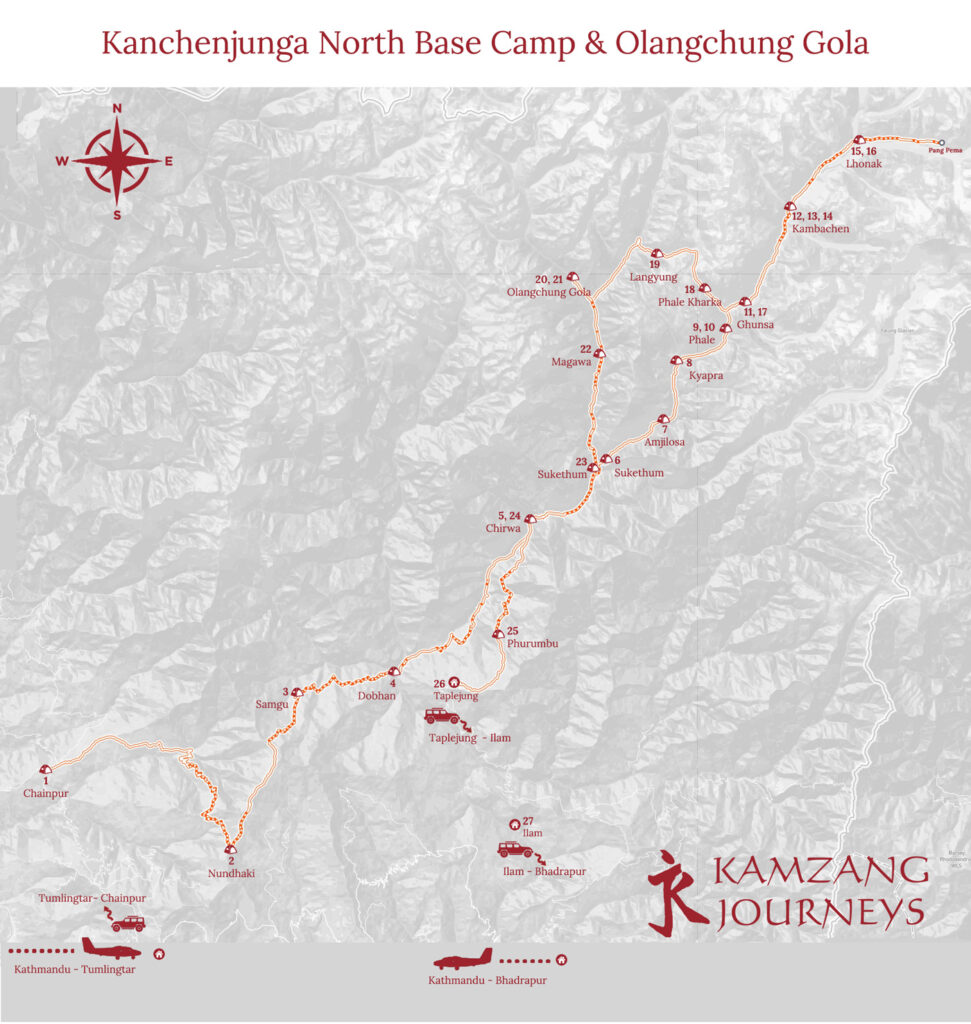
Map
Menu
Kamzang Journeys | Camping Menus
All meals on our Kamzang Journeys camping treks and cycling trips are prepared on site by our excellent chef Junar, our assistant chef Yam, and the hard-working kitchen team. The kitchen staff is well-trained in keeping the kitchen and food sanitized, and we sterilize all dishes, cups and utensils by steaming in boiling water before every use. All fruits and vegetables are soaked in iodine &/or baking soda, and our dining tent is well stocked with hand sanitizer, with soap and water for washing hands in front of the tent.
Much of our produce on the trip is organic, sourced from local villages to ensuring that it’s fresh, plentiful and sustainable We also buy meat, grains, potatoes, staples and whatever possible en route to provide much needed income to the local villagers. We cater to all sorts of dietary restrictions, including vegetarians and vegans, gluten-free, dairy-free and those with various food allergies and preferences. All of our meals are vegetarian, although most meals have additional meat options. Types of food we serve on our camping trips range from Asian (Nepali, Indian, Tibetan, Thai and Chinese) to Italian and Mexican, and we always have PLENTY of food to fill you up, and keep you fueled for the next day’s adventures!
Just one of the many reasons our trekkers and cyclists return year after year. A taste of what you’ll enjoy on our camping treks …
Breakfast
Freshly Ground Organic Coffee, Masala Chai & Teas
Freshly Baked Farmers’ Bread
Freshly Baked Wheat, Oat & Raisin Bread
Choice Of Eggs
Mexican, French & Masala Omelets
Aloo Anda (Potatoes & Scrambled Eggs)
Breakfast Burritos (Eggs, Tomatoes, Salsa, Cheese & Chapatti)
Huevos Rancheros (Eggs Rice, Beans Salsa & Chapatti)
Homemade Muesli
Porridges (Oat, Tsampa & Barley)
Crepes (Lemon, Chocolate & Local Apricot Jam)
Croissants (Sesame, Chocolate & Cheese)
Pancakes (Apple, Banana, Stacked & Buckwheat)
Dutch Baby Pancakes
Apple, Currant & Cinnamon Muffins
Cinnamon Spiced Rice Pudding
Cinnamon Rolls
Swedish Cardamon Rolls
Glazed Doughnuts
French Toast & Honey
Tibetan Bread With Local Jam
Cinnamon Sugar Chapattis
Masala Parathas & Sambar
Hash Browns
Fresh Fruit
Breads
Freshly Baked Farmers’ Bread
Freshly Baked Wheat & Oat Bread
Freshly Baked Cinnamon, Raisin & Nut Bread
Sun-Dried Tomato & Rosemary Flat Bread
Olive & Sundried Tomato Bread
Jalapeno & Cheese Corn Bread
Irish Soda & Currant Bread
Banana Bread
Zucchini Bread
Millet & Buckwheat Pancakes
Tai Roti (Paneer & Potato Bread)
Whole Wheat Roti & Chapattis
Cheese Biscuits
T Mo:Mos (Steamed Tibetan Bread)
Trail Lunch
Freshly Baked Breads
Himalayan Cheese
Herb & Olive Oil Paneer (Cottage Cheese)
Homemade Hummus & Baba Ghanoush
Herb & Olive Oil Infused Sun-Dried Tomatoes
Quinoa, Local Beans & Tahini Salad
Beet, Carrot & Cabbage Salad
Vegetable Fried Rice, Pilau & Biriyani
Kashmiri Rice (Coconut, Spices & Raisins)
Egg Fried, Lemon & Caribbean Tomato Rice
Mexican Rice & Beans
Thai Vegetable & Coconut Fried Rice
Vegetable Fried Potatoes
Potato & Celery Salad
Vegetable Fried Noodles
Chop Suey (Crispy Raman Noodles & Vegetables)
Tossed Pasta, Vegetable & Olive Oil Salads
Indian Samosas & Sweet Thai Chili
Millet Tabbouleh & Falafel
Smoked Salami
Tuna Salad
Deviled Eggs
Camp Lunch
Grilled Sandwiches (Tomato & Cheese, Cheese & Salami, Tuna & Cheese)
Tzadziki Wraps (Grilled Vegetables, Yogurt & Garlic)
Roasted Vegetable & Hummus Wraps
Asian Sesame & Bok Choy Noodles
Vegetable Spring Rolls & Asian Dipping Sauce
Chana Puri (Indian Chick Pea & Potato Ragout)
Sherpa Sha-Phaklay (Fried Mutton Flat Bread)
Baked Hand Pies (Vegetable & Paneer, Ham & Pea)
Thai Red Curry Coconut Noodles
Salads
Caesar Salad (Local Greens & Croutons)
Salad Niçoise & Isreali Salad
Beets, Paneer & Bread Panzanella
Soups & Stews
Fresh Pumpkin & Rosemary Soup
Fresh Potato & Spring Onion Soup
Fresh Carrot & Cilantro Soup
Fresh Chinese Tomato, Egg & Bok Choy Soup
Fresh Spinach & Mushroom Soup
Fresh Lentil & Local Beans Soup
French Onion Soup (Croutons & Cheese)
Fresh Nettle Soup
Spiced Coconut Carrot Soup
Fresh Pureed White & Black Bean Soup
Thai Tom Yum & Tom Kaa Soups (Bean Noodles)
Sherpa Shakpa (Potato, Shitake Mushroom & Vegetable Soup)
Tibetan Thukpa Noodle & Vegetable Soup
Asian Dried Mushroom, Ginger & Noodle Soup
Ramen Noodles With Egg & Vegetables
Thai Coconut & Coriander Soup
Tuscan Bread & Tomato Soup
Tomato Egg Drop Soup
Hot & Sour Soup With Chinese Dumplings
Spiced Chickpea Stew With Coconut & Turmeric
Dinner | General
Pizzas
Mexican Burritos
Mexican Baked Enchiladas & Rice-Beans
Southwestern Bean & Spinach Chili
Grilled Chicken & Mashed Potatoes
Quiche
Frittata
Couscous, Ratatouille & Italian Beans
Steamed Mo:Mos (Spinach, Paneer & Garlic, Potato & Cheese, Mutton)
Sherpa Potato Pancakes & Somar (Fermented Cheese, Green Onions & Chili)
Sherpa Shakpa (Potato & Vegetable, Potato (&/Or Meat) Stew)
Tibetan Thukpa (Noodle, Vegetable Soup)
Potato, Cheese, Onion (& Ham) Casserole
Mutton & Vegetable-Lentil Burgers
Polenta, Baked Vegetables & Cheese
Tuscan Fish & Potato Ragout
Gnocchi
Sushi Rolls
Dinner | Pasta
Spaghetti, Linguine & Penne Pastas
Italian Pasta Sauces (Vegetable, Garlic & Olive Oil, Bolognaise, Puttanesca, Carbonara)
Tossed Pastas (Pesto & Sun-Dried Tomatoes, Sautéed Garlic, Olives & Mushroom)
Lasagna (Spinach, Mushroom, Eggplant & Tomato)
Ravioli With Tomato, Spinach & Garlic Sauce (Mushroom & Spinach, Mushroom & Cheese, Ham, Pumpkin & Rosemary)
Mongolian Fried Sesame & Ginger Noodles (Vegetable & Mutton)
Dinner | Rice
Thai Masman, Panang, Red & Green Coconut Curries (Vegetable Or Chicken)
Bhutanese Ema Datsi (Chili & Cheese, Mushroom Or Potato)
Palak Paneer (Spinach & Paneer)
South Indian Coconut Vegetable & Chicken Curries
Shahi Paneer, Vegetable & Chicken Curries (Yogurt)
Butter Chicken & Mutton Masala Curries
Indian Masala Curries (Vegetable, Cauliflower, Mushroom, Pumpkin, Potato & Pea)
Masala Kofta (Potato & Paneer Curry)
Dal Makani (Black Dal & Butter) & Local Dals (Lentil Curries)
Asian Ginger Broccoli & Sesame Cabbage
Asian Black Bean Sauce (Vegetables & Tofu)
Chinese Egg & Tomato Curry
Chinese Stir-Fried Vegetables
Poha (Indian Flattened Rice)
Vegetables, Beans & Potatoes
French Fries (Chips)
Mashed Garlic & Roasted Potatoes
Italian Rosemary Sauteed Potatoes
Roasted Rosemary Beets & Sweet Potatoes
Italian Sauteed White Beans, Cabbage & Potatoes
Italian Sauteed Garlicky White Beans, Broccoli (Kale) & Lemon
Lana’s Stacked Green Vegetables (& Cheese)
Mashed Garlic Cauliflower
Baked Zucchini & Egg Casserole
Eggplant & Zucchini Parmesan
Stuffed Capsicum, Squash & Zucchini
Steamed Broccoli & Cauliflower, Olive Oil & Lemon
Coconut Sesame Vegetables
Japanese Vegetable Tempura
Chinese Ginger Vegetables
Alu Sandekho
Snacks
Cheese, Pate & Crackers
Potato Cheese Balls
Masala Papadum & Peanuts
Jalapeños & Cheese Quesadilla
Bruschetta (Tomato, Olive Oil & Olive Tapenade)
Garlic & Olive Oil Crustini
Tempura (Vegetables, Paneer & Rice Flour)
Pakora (Vegetables & Chick Pea Flour)
Green Pea Guacamole
Stuffed Pea Parathas
Indian Pakora & Tempura
Fried Potato, Rice & Corn Snacks
Cumin Nimkins
Desserts
Fresh Fruit Salad
Coffee-Infused Dark Chocolate Dumplings
Chocolate, Muesli & Nut Fortune Cookie Pastries
‘Marie’ Rum, Raisin & Chocolate Balls
Mango & Apple Cinnamon Crepes
Apple Pie & Crisp (Crumble)
Apple & Apricot Tarte
Apple, Apricot, Banana, Papaya & Plum Cobblers
Apple & Banana Fritters
Banana Flambe
Gulab Jamun (Indian Doughnut Holes)
Homemade Spiced Apple Sauce
Homemade Apple Pie
Apple, Carrot, Ginger & Pumpkin Spice Cakes
Bread & Butter Pudding
Spiced Pumpkin & Apple Suiji
Grated Apple Suji (Indian Semolina)
Soan Papdi (Indian Halva) & Kheer
Dark & White Chocolate Chunk Custard
Chocolate Chunk Pan Cookies
Dark Chocolate-Covered Digestives
Chai Masala Cookies
Lemon Bars
Brownies
No-Bake Chocolate Oat Bars (Peanut Butter)
Dark Chocolates
Coffee, Teas & Hot Drinks
Organic Coffee Beans
Masala Chail
Kashmiri Spiced Green Tea
Green & Assam Teas
Variety Of Dilmah Teas
Hot Chocolate
Lemon Ginger Tea
Grog
Kamzang Hot Rum Punch
Local Beers & Rum
Highlights & Reviews
Kamzang Journeys Reviews
Why Travel with Kamzang Journeys?
Why Trek with Us?
Kamzang Journeys Reviews!
Kamzang Journeys Reviews
Trek Highlights
- Kanchenjunga North Base Camp at Pang Pema
- Makalu Barun National Park
- Remote Olangchung Gola village
- Jannu viewpoint from Kambachen
- Ghunsa & Phale (Tibetan villages)
- Nango La & Lumba Sammba high routes
- Start in Nepal’s semi-tropical ‘middle hills’
- Himalayan panoramas & snow peaks
- Lots of wildlife
- A piece of ‘Old Tibet’
- Remote trekking with few other trekkers
- Kamzang-style camping
- Challenging trekking in the Nepal Himalaya!
Client Highlights
This was my third journey with Kim, Lhakpa and their fabulous Kamzang staff. Once again I was not disappointed. Kim and Lhakpa run a fantastic local company that prides itself on safety whilst taking their clients out of their comfort zone and getting them to experience remote and little seen areas of Asia. On this trek we visited the Kanchenjunga region, making it to the base camp.Over the Sumba-Lumba pass which was challenging, however totally worth the effort with amazing views from the top. Then we continued on through the magnificent Makalu region. The local knowledge, food, company and friendly staff make all of Kamzang Journeys something special. I will be back again next year!
– Sue W (Australia), GHT | Kanchenjunga Lumba Sumba to Makalu Barun Trek 2017
I had a minute to reflect on the past 9 weeks and I feel overwhelmed by how good the time has been. And in every memory, every achievement, every moment I feel a gratitude to both of you, Kim and Lhakpa, for making it possible and eternally memorable. Thank you for making this trip one of the most memorable ones in my lifetime. Kim, you have been a friend when I needed one, a leader when the group needed one, an impeccable organizer, and a great conversationalist. I marvel at your unlimited energy!
– Shiven M (USA & India),
Upper Dolpo to Jomsom
Everest High Passes
Last Nomads of Mustang
Kanchenjunga North Base Camp Trek
I have been with Kim and her crew on four separate treks into the Nepal Himalayas. Each one has been unique, exciting, challenging, and totally amazing. Kim has the best crew around and the Kamzang Journeys team provides a comfortable camp and great food. I would highly recommend Kim, Kamzang Journeys and her Himalayan trekking and cycling trips!
– Allan B (USA),
Amazing Annapurnas Trek
High Manaslu Trek,
Sacred Upper Dolpo to Mustang Trek
Kanchenjunga North Base Camp Trek
Trekking in the Himalaya, for me, was a lifelong dream. I am so glad I went with Kamzang Journeys on the Kanchenjunga to Makalu Trek! We had the most fantastic crew of porters who are cared for with kindness and compassion by Kim and Lhakpa. I felt like I was a part of something special, something beyond beautiful peaks and high passes. We were trekking during the month of the great earthquakes in Nepal in April – May 2015, so our trek had many challenges all of which were met with thoughtful consideration for our safety and the safety of our porters. We became a close-knit group. The terrain was dazzling, the food well thought out and very considerate of dietary restrictions all due to Kim’s careful planning. We had individual tents. Our Kamzang-style community tent was comfortable full of wonderful tea, rugs, sling chairs, books and music- making camp time a warm wonderful place to chill out. Kim has this absolutely sorted. Our trekking days were well managed, Kim’s genuine interest in the local people and her ability to communicate with the locals made our village visits intimate. This was a trek of a lifetime for me, which I am happy to say will be the first of many with the wonderful Kamzang team. I feel like I have made friends in this exotic exhilarating corner of the world.
– Shannon F (Australia), GHT | Kanchenjunga Lumba Sumba to Makalu Barun Trek 2015
Kim (Kamzang Journeys) manages a great trek! She’s personable, fun and takes responsibility to make everything work as well as possible given sometimes challenging circumstances. Kim truly loves Nepal and its people. It shows in the many ways she engages with the local people. She tries very hard to provide a great experience that works for everyone on the trek.
– Rick T (USA), Kanchenjunga North Base Camp Trek 2013
Kim Bannister Photo Gallery | Trip + Trek Photos
Kim Bannister Photography
Travel Reading | Enhance Your Trip!
Travel Books
Articles on Kanchenjunga
Lumba Sumba Pass | Great Himalayan Trail | ECS Online Magazine
India, Nepal & Bhutan Unite to Protect Kanchjunga – Mail Online India
Trekking Nepal’s Forgotten Mountain – BBC
Faces of Kanchenjuna – Blog, DreamWanderlust
Five Mountains Deadlier than Everest – Mental Floss
Kanchenjunga – Great Himalayan Trail
Kanchenjunga – Britannica
Dolpo Prints & Paintings
Dolpo Artist Tenzin Norbu creates wonderful Dolpo paintings, the prints (and some originals) available from our Cafe Caravan at Boudhanath.
Contact & Details
Kamzang Journeys Contact
Kim Bannister
kim@kamzang.com
kamzangkim@gmail.com
Mobile: +(977) 9803414745 (WhatsApp), 9863196743
On-Trek Satellite Phone: +88216 21277980 (Nepal)
Kathmandu Contact
Khumbu Adventures
hiking.guide@gmail.com
Lhakpa Dorji Sherpa Mobile: +(977) 9841235461, 9705235461
Doma Sherpa Mobile: +(977) 9841510833, 9705510833
Nuru Wangdi Sherpa Mobile: +977 9803633783 (WhatsApp)
Follow Us on Facebook
Kamzang Journeys Facebook
Kathmandu Arrival Hotel
Kathmandu Guest House
Nepal Tourist Visas
You can get your Nepal visa at TIA International Airport (or any land border) when you arrive in Nepal, or before you leave home at a Nepali Embassy or Consulate. When you arrive at immigration in Kathmandu, scan your passport at the visa machines (no photo needed) or produce your online, printed visa-on-arrival form, pay the visa fee, and go to the appropriate immigration line.
15 Days – $30
30 Days – $50
90 Days – $125
Tourist Visa Extension (15 days) – $45 (+$3 Additional Day))
Nepal Visa
Nepal Visa Information
Kathmandu Guest House
Ward: 16, Street name: Saatghumti, Area: Thamel, District: Bagmati, City: Kathmandu, Zone: Bagmati, Phone: +977 14700004
Health Information
Nepal Health Information
CDC
We also recommend bringing probiotics with you to help prevent infections while on trek. Doctor’s recommendation!
Travel Medical Insurance
Required for your own safety. We carry a copy of your insurance with all contact, personal and policy information with us on the trek and our office in Kathmandu keeps a copy. Note that we almost always trek over 4000 meters (13,000′) and that we don’t do any technical climbing with ropes, ice axes or crampons.
Global Rescue Rescue Services
We recommend (but don’t require) that our trekkers sign up for Global Rescue services as a supplement to your travel medical insurance. You can book this directly through our Kamzang Journeys site.
Global Rescue
Medical On-Trek
Please do have a full check-up before leaving home, and inform us of any medical issues. This is for YOUR OWN safety. Your guides bring a small medical kit, but you’ll want your own medications with you.
DO bring all prescription medications and rehydration powders-electrolytes. We advise bringing your own Diamox, Ciprofloxin, Azithromycin + Augmentin. We do have all of these with us, but the Western versions are generally more reliable than the Indian equivalents. See Gear List for a full list of recommended medications for the trek.
Travel Reading | Enhance Your Trip!
Travel Books
Not Enough of Nepal?
We highly suggest taking advantage of your trip to Nepal, adding on excursions into the Kathmandu Valley, Pokhara, Bandipur, Gorkha, the Annapurna Foothills, and Chitwan and Bardia National Park. Enjoy heritage tours, mountain biking, Kathmandu valley hiking, Himalayan panoramas (and a hike down) from the Chandragiri Cable Car, whitewater rafting, yoga and meditation courses, Nepali cooking classes, Buddhist or Hindu retreats, and much more. There are many wonderful, boutique, luxury, and heritage lodges in the Kathmandu Valley, and many options for world heritage sightseeing tours, bicycle trips, hikes, and craft-cuisine tours. Nepal boasts world-class restaurants, chic cafes, timeless alleyways to wander through, countless Hindu and Buddhist festivals, and lots of great shopping.
Don’t miss an Everest sightseeing flight or epic helicopter tour, sightseeing trips to Bhaktapur, Patan, and Panauti (Kathmandu Valley’s other historic and/or capital cities), a weekend at Shivapuri Heights Resort or Dwarikas in Kathmandu, a night at the Fort Hotel in Nagarkot for sunrise and sunset Himalayan panoramas, a spa and wellness getaway at the ultra-luxurious Dwarikas Dhulikhel Resort and visits to ancient temple and monastery complexes such as Namo Buddha, Changu Narayan, and Dakshinkali. Spend a night at The Old Inn in Bandipur or Three Mountain Lodge en route to Pokhara, or The Famous Farm in Nuwakot, and get to know Nepal’s Newar heritage.
Enjoy a luxury 3-6 day trek in the Annapurna Foothills, staying in the wonderful Ker & Downey luxury lodges. Relax in heritage style at Temple Tree Resort in Pokhara for some pampering at the spa and infinity pool, try out paragliding, zip-lining, and enjoy a morning of boating on the lake and the hike to Shanti Stupa. Once refreshed, drive to Chitwan National Park, spending 2 or 3 nights at Maruni Sanctuary Resort or Tiger Tops Tharu Lodge for wildlife and bird spotting, river trips, and safaris in style. Tiger Tops also owns Karnali Lodge at Bardia National Park, reached by flight from Kathmandu, and there are nearby archeological sights to visit nearby.
Nepal Modules
Nepal & Kathmandu Modules | Customize Your Trip!
Notes on Itinerary
Although we try to follow our trek itinerary, it is ONLY a guideline based on years of experience trekking in many Himalayan regions. At times local trail, river or weather conditions may make a deviation necessary; rivers may be impassible, snow blocks passes, and landslides wipe out trails. The trekking itinerary and campsites may also vary slightly depending on the group’s acclimatization rate or sickness, or improved campsites and lodges.
The Himalaya are our passion, and we take our trekking and cycling trips seriously. Although everyone is here on vacation, please come with a dollop of patience and compassion added to your sense of adventure …
Arrival Kathmandu
Arrival in Kathmandu
You will be met at the airport by a representative from Khumbu Adventures (see Contact & Details tab). Look for a sign with your name on it as you leave the airport. You will be transferred to the Kathmandu Guest House where your rooms have been pre-booked … Please hydrate!
Nepal Tourist Visas
You can get your Nepal visa at TIA International Airport (or any land border) when you arrive in Nepal, or before you leave home at a Nepali Embassy or Consulate. When you arrive at immigration in Kathmandu, scan your passport at the visa machines (no photo needed) or produce your online, printed visa-on-arrival form, pay the visa fee, and go to the appropriate immigration line.
15 Days – $30
30 Days – $50
90 Days – $125
Tourist Visa Extension (15 days) – $45 (+$3 Additional Day))
Nepal Visa
Nepal Visa Information
Kathmandu Guest House
Ward: 16, Street name: Saatghumti, Area: Thamel, District: Bagmati, City: Kathmandu, Zone: Bagmati, Phone: +977 14700004
Arrival Hotel
Kathmandu Guest House
International Medical Center Kathmandu
CIWEC
Nepal Temperatures + Clothing
See Gear Tab for trekking and cycling clothing, as well as medical supplies recommendations.
Kathmandu during the spring and autumn trekking seasons is usually quite warm (t-shirt, sandals, light pants or skirts) during the day, and gets chilly (light fleece or jacket) in the late afternoon and evenings. Nights can be cold enough for a sweater and/or jacket, or warm enough for t-shirts. Summer is hotter and wetter, and you’ll need a rain jacket and umbrella. The winter months (late Nov – March) are chilly in the mornings and evenings, cold enough that you might start the day in a down jacket, but often warming up enough to wear a t-shirt by mid-day. Nights get cold enough for a down jacket if you’re sitting outside, although many restaurants have heaters or fire pits. It never snows in Kathmandu. Keens, Chacos or other hiking sandals are great for wandering around Kathmandu, and for trekking in lower altitudes. Crocs are good to have for rooms, showers and at camp when trekking or cycling.
Trekking is a mixed bag of temperatures. LAYERS are the key as hot can change quickly to freezing crossing the passes and snowfalls are common. We often have some rain below 3000 meters in the spring and early autumn, and it can rain hard in the summer. Have a wide range of layer-able trekking clothes for summer to winter temperatures. Keep a lightweight down jacket or synthetic jacket with you at all times, available inexpensively in Kathmandu. A lightweight rain poncho and umbrella for trekking are recommended in the spring and summer seasons. Be prepared! See our ‘Gear’ tab for full details on gear, shoes, clothing, electronics, and meds for the trek.
There are lots of real gear shops (North Face, Mountain Hardwear, Marmot, Sherpa Gear, OR) and many ‘fake’ and Nepali-made shops in Kathmandu, so if you don’t think you have the right gear starting the trip, it is easy to pick up gear once in Kathmandu. We have sleeping bags to rent, duffel bags, camp towels and buffs to purchase, and you’ll get a FREE Kamzang Journeys t-shirt for the trip!
Dress conservatively in Kathmandu and on the trail as a rule. Shorts are okay if they aren’t too short, short mini skirts aren’t recommended. Sleeveless t-shirts are absolutely fine, but perhaps avoid skimpy tank tops on the trail. Super tight lycra and very skimpy doesn’t go over so well with village elders or remote villagers, and will generally limit your ability to have meaningful interactions with Nepali villagers. Many of the younger generation in Nepal wear modern Indian or Western-influenced clothes but remember that you haven’t signed up for a beach or surf vacation. Use your good judgment, and be an ambassador for western travelers! Please ask Kim or your guide if unsure about appropriate clothing, we’re always happy to advise.
Nepal Cultural Issues
Nepalis are very open and welcoming, but there are a few issues you should be aware of to make your stay in Nepal more fulfilling. Use your right hand to pass things, shake hands or do most anything. Left hands are somewhat taboo. Nepalis often place their left hand on the right forearm when passing things to others, a sign of respect. Best not to pat kids on heads, or point feet ahead of you at monasteries. Don’t walk over someone’s legs or feet, but put your hand down in front of you to signal them to pull their legs to the side. Take off shoes and hats when going into Buddhist monasteries and Hindu temples, don’t use flashes inside monasteries or temples if possible and be respectful when attending pujas (prayer ceremonies). You can talk and move around, all religious are very tolerant, but be aware of your level of voice and where you are walking. Don’t sit on Buddhist monastery benches, they are used as tables. You will often be shown to low, carpeted sitting areas in the back of a monastery. If you’re served tea, it’s fine to accept (in fact, the servers will be happy to give you tea), but also fine to say ‘no thank you’, putting your hand up. If you don’t want more tea, often the salt-butter variety, simply cover your cup with your hand.
Nepalis don’t anger quickly in general, so try not to raise your voice if exasperated or angry as it only will make the situation worse. Do bargain at shops, with taxis and rickshaws, but don’t fleece people as many people are quite poor and need to make a living. Give small donations on the streets if you choose to, but try not to encourage begging and be aware of who you are giving your money to. If you do want to donate to a good cause, ask about our Kamzang Fund or other responsible organizations.
Tips for Staff
We recommend $250-300 per person to go into the tip pool for the staff, which can be given to Kim in Kathmandu in $US. We also pitch in to buy our incredible staff drinks on the last night, or any other night that you feel like treating them to a bottle of Kukure Rum or a few beers!
Tips in General
Tips are always appreciated but they don’t need to be extravagant. 100-300 NRP to carry bags to/from your room is fine, the women who clean your room will be happy with 200-300 NRP when you leave, and 300-500 NRP is great for your airport transfers. Round-up taxi fares, in general. A larger tip would be expected for a day trip in a private car, perhaps 500 NRP, and a tour guide might get 500-100 NRP. 10% is included in most restaurant and hotel bills in Nepal, and if it’s not included it’s still expected. You can round-up the restaurant bills as well.
Cash, Credit Cards & ATMs
ATMs are available all over Kathmandu, and give up to 25,000 NRP per transaction, in general. You can also change money at the hotel counter (a good rate usually) or just outside the hotel at any of the money changers. They’re quite competitive. You’ll want cash in NRP with you on the trek for local shopping, drinks, beers, snacks, beer, laundry and charging electronics. There are usually local crafts and textiles to buy along the way as well! Credit cards are accepted at hotels, most larger restaurants and cafes, and most of the larger gear, craft and pashmina shops in Kathmandu.
Pampering Yourself & Shopping in Kathmandu
We’re happy to book your rooms before or after the trek at boutique and luxury hotels, resorts and spas in Kathmandu and the Kathmandu Valley. We’re happy to help with advice on where to purchase the most authentic crafts, pashmina or other hand-made Nepali products in Kathmandu. We sell local handicrafts at our Cafe Caravan at Boudha, as well as delicious cakes, coffees, meals and snacks.
Cafe Caravan & Dolpo Prints & Paintings
Dolpo Artist Tenzin Norbu creates wonderful Dolpo paintings, the prints (and some originals) available from our Cafe Caravan at Boudhanath Stupa, and more recently the artist Tenzing Samdup also sells his Dolpo prints at the cafe. We also have an extensive selection of ‘caravan’ handicrafts, coffees, teas, t-shirts, ceramic mugs and Himalayan books for sale …
Kamzang Journeys Products
Kamzang Journeys duffel bags, Kamzang Journeys t-shirts, Kamzang Journeys camp towels, Kamzang Journeys buffs, handcrafted leather passport wallets, totes and bags, handcrafted Himalayan textile pillow covers and more unique, handcrafted tribal silver and Himalayan textiles available from Kim here in Kathmandu.
Kamzang Journeys Products
Kamzang Design Etsy Shop (On-Line)
Many of these handcrafted products designed by Kim and local craftspeople are available in Kathmandu, including much of the tribal silver collection …
Kamzang Design Etsy Shop
Great Stays
See our ‘Great Stays’ tab for our picks of some of the best heritage, boutique or interesting hotels, guest houses, and lodges in the Kathmandu Valley and elsewhere in Nepal.
Not Enough of Nepal?
We highly suggest taking advantage of your trip to Nepal, adding on excursions into the Kathmandu Valley, Pokhara, Bandipur, Gorkha, the Annapurna Foothills, and Chitwan and Bardia National Park. Enjoy heritage tours, mountain biking, Kathmandu valley hiking, Himalayan panoramas (and a hike down) from the Chandragiri Cable Car, whitewater rafting, yoga and meditation courses, Nepali cooking classes, Buddhist or Hindu retreats, and much more. There are many wonderful, boutique, luxury, and heritage lodges in the Kathmandu Valley, and many options for world heritage sightseeing tours, bicycle trips, hikes, and craft-cuisine tours. Nepal boasts world-class restaurants, chic cafes, timeless alleyways to wander through, countless Hindu and Buddhist festivals, and lots of great shopping.
Don’t miss an Everest sightseeing flight or epic helicopter tour, sightseeing trips to Bhaktapur, Patan, and Panauti (Kathmandu Valley’s other historic and/or capital cities), a weekend at Shivapuri Heights Resort or Dwarikas in Kathmandu, a night at the Fort Hotel in Nagarkot for sunrise and sunset Himalayan panoramas, a spa and wellness getaway at the ultra-luxurious Dwarikas Dhulikhel Resort and visits to ancient temple and monastery complexes such as Namo Buddha, Changu Narayan, and Dakshinkali. Spend a night at The Old Inn in Bandipur or Three Mountain Lodge en route to Pokhara, or The Famous Farm in Nuwakot, and get to know Nepal’s Newar heritage.
Enjoy a luxury 3-6 day trek in the Annapurna Foothills, staying in the wonderful Ker & Downey luxury lodges. Relax in heritage style at Temple Tree Resort in Pokhara for some pampering at the spa and infinity pool, try out paragliding, zip-lining, and enjoy a morning of boating on the lake and the hike to Shanti Stupa. Once refreshed, drive to Chitwan National Park, spending 2 or 3 nights at Maruni Sanctuary Resort or Tiger Tops Tharu Lodge for wildlife and bird spotting, river trips, and safaris in style. Tiger Tops also owns Karnali Lodge at Bardia National Park, reached by flight from Kathmandu, and there are nearby archeological sights to visit nearby.
Nepal Modules
Nepal & Kathmandu Modules | Customize Your Trip!
Kathmandu Valley Sightseeing & Tours
See our Kathmandu Tours tab for lots of idea of how to experience the real Nepal.
Kathmandu & Kathmandu Valley Information
Our ‘Insider’ list of things to do, places to go, what to visit, the most happening restaurants and the best hotels in Kathmandu and the beautiful Kathmandu Valley.
Happenings in Kathmandu
Gear
Kamzang Journeys Products
Kamzang Journeys duffel bags, t-shirts, camp towels and buffs. Handcrafted leather passport wallets, totes and bags, unique Himalayan textile pillow covers, cashmere stoles and more!
Kamzang Journeys Products
Gear List (Nepal Lodge Treks)
A guideline, not a bible, for the gear you will (probably) need on the trek. Do ask (or send gear links) if you have questions. Everyone has their own method of gearing-ups for the mountain, so although these suggestions are based on 20+ years of Himalayan trekking, individuals have gear preferences. Layers are essential for trekking. Quality is more important than quantity. It’s worth investing in some newer, warmer, lightweight trekking gear! If you need, someone from Kamzang Journeys or Khumbu Adventures will check your gear before the trek …
One duffel bag per person. If flying, the airline baggage allowance is 15 kg (33 lbs) per person for mountain flights (including your daypack). We’ll help find ways to adjust what you wear and pack in Kathmandu (for Nepal treks), but be aware and try to limit your duffel bag and daypack to 20 kg total. 20 kg (44 lbs) weight limit for treks. You won’t be able to bring everything on this list, so use this list as a guideline.
- Duffel Bag (KJ Duffel Bags Available – See KJ Products)
- Day Pack (30-45 L)
- Sleeping Bag (-20 to 0F/-15 to -25C Recommended)
- Trekking Boots, Trekking Shoes &/or Running Shoes
- Crocs (Evenings & Washing)
- Down Jacket(s) &/or Vests (Can be Lightweight Down Jackets. Layering Recommended)
- Technical Jacket (Depending on Other Jackets)
- Wind/Rain Jacket & Pants (Inquire for Your Trek)
- Trekking Pants (2)
- T-Shirts (2-3)
- Long-Sleeve Shirts (2-3)
- Thermal (Lightweight) Top & Bottom
- Evening Thermal Top & Bottom (Synthetic &/or Down Pants Optional)
- Socks (4)
- Down Booties (Optional)
- Gloves
- Thermal Hat
- Baseball Cap &/or Wide-Brimmed Hat
- Camp Towel
- Trekking Poles (Recommended)
- Sunglasses (Extra Pair Recommended)
- Reading Glasses (Extra Pair Recommended)
- Head Lamp (Extra Recommended)
- Water Bottles | Nalgene or Metal Bottles (2-3)
- Water Bladder (Optional, Recommended)
- Watch (or Phone Alarm)
- Battery Chargers & Extra Batteries
- Camera or Smart Phone (Optional)
- USB Adapter with Multiple Ports (Recommended)
- SteriPen &/or Squeeze Filter Bottle (Optional – We Provide Filtered Drinking Water)
- Umbrella (Optional)
- Laundry Detergent or Bio-degradable Clothes Soap
- Zip-Locks &/or Plastic Bags
- Soft Toilet Paper
- Toiletries
- SPF Sunscreen & SPF Lip Balm
- Personal Medical Supplies
- Hand Sanitizers (Small)
- Reusable Wipes (Recommended, Not Single Use)
- Rehydration | Electrolytes (Required)
- Snacks (Required)
For Passes
- Micro Spikes (REQUIRED for Passes – Inquire for Your Trek)
- Heavy Gloves
- Trekking Poles
Annapurna Foothills Trek & Lower Altitude Treks
- Sleeping Bag (3 Season)
- Down or Synthetic Jacket (Lighter Weight)
- Trekking Clothes (Spring or Autumn instead of Winter)
Shopping & Snacks in Nepal
Almost all gear is now available in Kathmandu, from real (North Face, Mountain Hardwear, Sherpa Gear, Marmot or at some select shops in Thamel such as Sonam) to inexpensive knock-offs or good Nepali brands. The real gear shops take credit cards. There are many camera and mobile shops, and you can pick up good quality chocolate, snack bars (including gluten free, organic and vegan) and lots of other varieties dried fruits, nuts and snacks in Kathmandu. And, of course, you can shop for pashminas (or cashmere, or fakes, please ask if unsure), good quality silver, handicrafts and locally produced specialty products. We also have a large variety of good quality, unique handicrafts at Café Caravan in Boudhanath.
Lodge Note
In traditional lodges, the dining rooms will often be heated by wood or yak-dung stoves and the bed rooms will not have heat. You will need a sleeping bag and towel. Mornings and evenings in the rooms are chilly to cold, and before the stoves are lit you’ll want to put on your thermals! There are almost always duvets, blankets or quilts available (always in the Everest region, sometimes in other regions). Bring an appropriate sleeping bag for your trekking region and time of year; inquire and we will help you decide what temperature rating is right for your trek!
Suggested Medical Supplies
Your guide will have a have a small medical kit, including Diamox (for acclimatizing), antibiotics, bandages, re-hydration, antihistamines, painkillers and anti-inflammatory drugs. Please bring a supply of all prescription and personal medications. Please have a check-up before leaving home, and inform us of any medical issues. This is for YOUR OWN safety!
SUGGESTED MEDS | Dexamethasone, Nifedipine & Diamox (Acetazolamide) (altitude), Azithromycin, Ciprofloxacin, Augmentin (amoxicillin, penicillin-based & clavulanate potassium), Cephalosporin (antibiotics), blister bandages, Tegaderm & wound bandages & tape, antibiotic, iodine and antiseptic ointments, knee & ankle supports (if required), ACE bandage for sprains & strains, cough drops.
Bring whatever pain meds you generally use (Ibuprofen, Paracetamol, Acetaminophen, Tylenol, Diclofenac, Naproxen), meds for diarrhea (Loperamide, Imodium) and nausea (Ondansetron), antihistamines (non-drowsy, and Benadryl is a drowsy antihistamine that might help with sleep), as well as any medications that you take regularly or that your doctor prescribes. We recommend picking up a combination Salmeterol & Fluticasone inhaler locally, good for (from a doctor trekking friend) “high altitude cough due to reactive airways, which is kind of like temporary asthma. The ingredients in the inhaler relax the bronchial passages and calm inflammation in the airways.” Stay away from sleeping medications, drugs in the codeine-opiate-narcotic family and other drugs that suppress your breathing (not a good at altitude). And don’t forget electrolytes! Have some with you in your pack (as well as snacks) daily …
We’re happy to take excess medical supplies off your hands when you leave if you won’t need them. We use lots of the large amount we have with us to treat locals, our staff and our trekkers…
Kim’s Gear Suggestions
I generally wear a trekking t-shirt, trekking pants, a mid-weight long-sleeve shirt, a lightweight synthetic jacket (sometimes paired with a vest), often starting the morning in a lightweight pair of long underwear. I carry a lightweight wind-rain jacket and pants, an extra pair of socks, gloves, a baseball cap and hat in my daypack, and on colder days also have a lightweight down jacket with me.
I use a 35 L Osprey daypack with a bladder, and an extra Nalgene to refill water on the trail, and often use trekking poles. I generally trek in heavier running shoes, although I use boots on very cold days and over passes, and sometimes on hot days at lower altitudes (not in the winter) I also trek in Chaco sandals. I often carry Crocs with me in case of river crossings and to give my feet a break at lunch (Tevas, Chacos and Keen sandals take a long time to dry and are relatively heavy), and I carry micro-spikes on pass days. I always have snacks, electrolytes, my camera or iPhone, sunscreen, hand sanitizer and some toilet paper, a small medical kit and a SteriPen.
Good trekking boots, hiking shoes or running shoes that you’ve hiked in before the trek are essential. You don’t ever need climbing or plastic boots (for mini-crampons or micro-spikes). Trekking poles are not required but strongly recommended, especially for going down passes which are often steep and icy, and for treks with river crossings and rocky trails. Bring gators if you tend to use them but they’re not required if you don’t own a pair. Micro-spikes (mini-crampons) or YakTrax are useful (often essential) for pass crossings. Inquire before your trek!
Good (polarized) sunglasses are essential. Do bring an extra pair in case you lose or break them. Don’t forget a sun hat and/or a baseball cap, perhaps an extra headlamp, and have plenty of sunscreen and lip balm with SPF! Don’t get caught with blistered lips that don’t heal at altitude.
Nights are chilly to very cold, so a down jacket(s) and a warm sleeping bag are essentials. We recommend a down sleeping bag of -10 to -20 F (-18 to -28 C). Mine is -20 F. At lower altitudes I open it and sleep under it like a quilt, and up higher am toasty warm during cold nights. NOTE sleeping bag ratings don’t correspond to how warm they need to be at altitude. Lodges at higher altitudes can be freezing at night and in the morning. I change into thermals for the evening, and to sleep in. Often stretchy yoga pants or down or synthetic pants over thermal underwear, light down vest and/or jacket over thermal layers. I love my down (or synthetic) booties at night, though they are not essential in the lodges!
Bring XL plastic bags or stuff sacks in your daypack in case of rain. The weather is changeable in the Himalaya, so we recommend that everyone has a strong, waterproof duffel bag for the trek.
Day Pack
We recommend a 30-45 liter day pack. Better to have it too large than too small as on pass days (on some treks) you’ll need to carry more warm gear, and you can always cinch daypacks down. Many packs come with internal water bladders, or you can purchase them separately; very good for ensuring that you stay hydrated. Make sure your pack fits comfortably when loaded before bringing it trekking!
In your day pack, you’ll carry your camera or phone, approximately 1½ – 2 liters of water, a jacket, lightweight wind and/or rain pants (often), a thermal hat, a baseball cap or sun hat, a buff or neck gator (optional, but great to have on dusty trails), gloves, sunscreen, snacks, electrolytes, maybe something to purify water, hand sanitizer, a small medical kit, a pack-cover and often a lightweight down jacket. You might want your Crocs in for lunchtime stops or unexpected river crossings.
Drinking Water
We bring a water filter along on the trek for fresh drinking water, ecologically the best way to get water in the Himalaya’s fragile trekking regions. Bring your own SteriPen or Sawyer squeeze filter for a back-up filtered water system during the day, if you already have one. Please bring at least 2 Nalgene or other water bottles in addition to your water bladder.
Snacks
You will NEED snacks hiking at altitude, even if you’re not a big snacker. Bring your favorite energy bars, gels, chocolate bars, dried fruit and nuts, jerky or whatever else gives you quick energy. Emergen-C, Nuun or any other electrolyte mixes are important in water bottles or before or after the trekking day. It is ESSENTIAL to bring electrolytes with you in your day packs in case you cramp up, get diarrhea or otherwise need them. See Nutrition & Hydration PDF for more details …
Rentals
We have (approximately) 0F super-down sleeping bags to rent for $2.50 per day on our Nepal & Tibet treks. You might want a warmer sleeping bag (I use a -20F); if so, please do bring your own, as we want you to be warm while sleeping at night!
Packing & Extra Gear Storage
It’s easy to pack and unpack from a duffel bag, especially when the temperature drops. It’s a good idea to invest in a strong, waterproof duffel such as a North Face or one of our Kamzang Journeys duffels. You can store extra gear and computers at the hotel while we’re trekking.
Kanchenjunga
Kanchenjunga Region
Majestic Kanchenjunga (8598 meters) is the world’s third highest mountain, surpassed only by Everest and K2. It is certainly one of the most spectacular massifs in the Himalayan range, rising majestically from the borders of Nepal and Sikkim (India). The region, inhabited by Tibetans and Limbus living in remote mountain villages, can be approached by both the Nepal and the Indian sides. Our trek along the Great Himalayan Trail to Kanchenjunga begins in Tumlingtar, in the Makalu region of Nepal.
Kanchenjunga is worshiped by the Tibetans in Sikkim as the home of their protector gods so isn’t climbed as much as the other Himalayan mountains. The first attempt to climb Kanchenjunga was in 1905 by Aleister Crowley, but the first successful attempt at climbing wasn’t until the British expedition of 1955. Located east of the great cleft of the Arun Salpa valley, the Kanchenjunga region receives the heaviest monsoon rains in all of the Himalaya. Its middle hills are lush, green and semi-tropical, full of seasonal flowers and foliage. Opened to trekking 1988, the Kanchenjunga region provides an opportunity to visit Rai and Limbu villages in the lush middle hills, and pristine forests, Himalayan glaciers and far-flung Tibetan villages higher up.
The Myth of Kanchenjunga
“The area around Kangchenjunga is said to be home to a mountain deity, called Dzö-nga (Kangchenjunga Demon) a type of yeti or rakshasa. A British geological expedition in 1925 spotted a bipedal creature which they asked the locals about, who referred to it as the Kangchenjunga Demon.
For generations, there have been legends recounted by the inhabitants of the areas surrounding Kanchenjunga, both in Sikkim and in Nepal, that there is a valley of immortality hidden on its slopes. These stories are well known to both the original inhabitants of the area, the Lepcha people and Limbu people, and those of the Tibetan Buddhist cultural tradition. In Tibetan, this valley is known as Beyul Demoshong. In 1962, a Tibetan Lama by the name of Tulshuk Lingpa led over 300 followers into the high snow slopes of Kanchenjunga, to ‘open the way’ to Beyul Demoshong. The story of this expedition is recounted in the 2011 book A Step Away from Paradise.” – Wiikipedia
Kanchenjunga First Ascent
“1955 British Kangchenjunga Expedition: Neil Mather, John Angelo Jackson, Charles Evans and Joe Brown, Tony Streather, Norman Hardie, George Band and Prof John Clegg. In 1955, Joe Brown and George Band made the first ascent on 25 May, followed by Norman Hardie and Tony Streather on 26 May. The full team also included John Clegg (team doctor) Charles Evans (team leader), John Angelo Jackson, Neil Mather and Tom Mackinnon. The ascent proved that Aleister Crowley’s 1905 route (also investigated by the 1954 reconnaissance) was viable. The route starts on the Yalung Glacier to the southwest of the peak, and climbs the Yalung Face, which is 3000m. The main feature of this face is the ‘Great Shelf’, a large sloping plateau at around 7500m covered by a hanging glacier. The route is almost entirely on snow, glacier and one icefall; the summit ridge itself can involve a small amount of travel on rock. The first ascent expedition made six camps above their base camp, two below the Shelf, two on it, and two above it. They started on 18 April, and everyone was back to base camp by 28 May.” – Wikipedia
Kathmandu Tours
Not Enough of Nepal?
We highly suggest taking advantage of your trip to Nepal, adding on excursions into the Kathmandu Valley, Pokhara, Bandipur, Gorkha, the Annapurna Foothills, and Chitwan and Bardia National Park. Enjoy heritage tours, mountain biking, Kathmandu valley hiking, Himalayan panoramas with a hike down from the Chandragiri Cable Car, whitewater rafting, yoga and meditation courses, Nepali cooking classes, Buddhist or Hindu retreats, and much more. There are many wonderful, boutique, luxury, and heritage lodges in the Kathmandu Valley, and many options for world heritage sightseeing tours, bicycle trips, hikes, and craft-cuisine tours. Nepal boasts world-class restaurants, chic cafes, timeless alleyways to wander through, countless Hindu and Buddhist festivals, and lots of great shopping.
Don’t miss an Everest sightseeing flight or epic helicopter tour, sightseeing trips to Bhaktapur, Patan, and Panauti (Kathmandu Valley’s other historic and/or capital cities), a weekend at Shivapuri Heights Resort or Dwarikas in Kathmandu, a night at the Fort Hotel in Nagarkot for sunrise and sunset Himalayan panoramas, a spa and wellness getaway at the ultra-luxurious Dwarikas Dhulikhel Resort and visits to ancient temple and monastery complexes such as Namo Buddha, Changu Narayan, and Dakshinkali. Spend a night at The Old Inn in Bandipur or Three Mountain Lodge en route to Pokhara, or The Famous Farm in Nuwakot, and get to know Nepal’s Newar heritage.
Enjoy a luxury 3-6 day trek in the Annapurna Foothills, staying in the wonderful Ker & Downey luxury lodges. Relax in heritage style at Temple Tree Resort in Pokhara for some pampering at the spa and infinity pool, try out paragliding, zip-lining, and enjoy a morning of boating on the lake and the hike to Shanti Stupa. Once refreshed, drive to Chitwan National Park, spending a few nights at Maruni Sanctuary Resort or Tiger Tops Tharu Lodge for wildlife and bird spotting, river trips, and safaris in style. Tiger Tops also owns Karnali Lodge at Bardia National Park, reached by flight from Kathmandu, and there are nearby archeological sites to visit nearby.
Namaste!
Nepal Modules
Nepal & Kathmandu Modules | Customize Your Trip!
Kathmandu Valley Guided Sightseeing Day Tours
+ Kathmandu World Heritage Guided Sightseeing Tour (Full Day) | Pashupatinath, Boudhanath & Swayambunath ($125)
+ Kathmandu World Heritage Guided Sightseeing Tour (Half Day) | Pashupatinath & Boudhanath ($75)
+ Kathmandu World Heritage Sightseeing Car – No Guide (Morning or Evening) | Swayambunath ($35)
+ Kathmandu World Heritage Guided Walking Tour (Half Day) | Kathmandu Durbar Square ($50)
+ Kathmandu World Heritage Guided Tour (Half Day) | Patan Durbar Square ($65)
+ Kathmandu Valley World Heritage Sightseeing Tour (Full Day) | Bhaktapur & Changu Narayan ($135)
+ Kathmandu Valley Heritage + Craft Tour (Custom Tours)
+ Cycling Trip in Kathmandu Valley (Custom Trips)
+ Everest Express Sightseeing Flight ($225)
+ Everest Sightseeing Helicopter Tour (Custom Tours)
TOUR NOTE | Additional tour member + $30. Entrance fees not included.
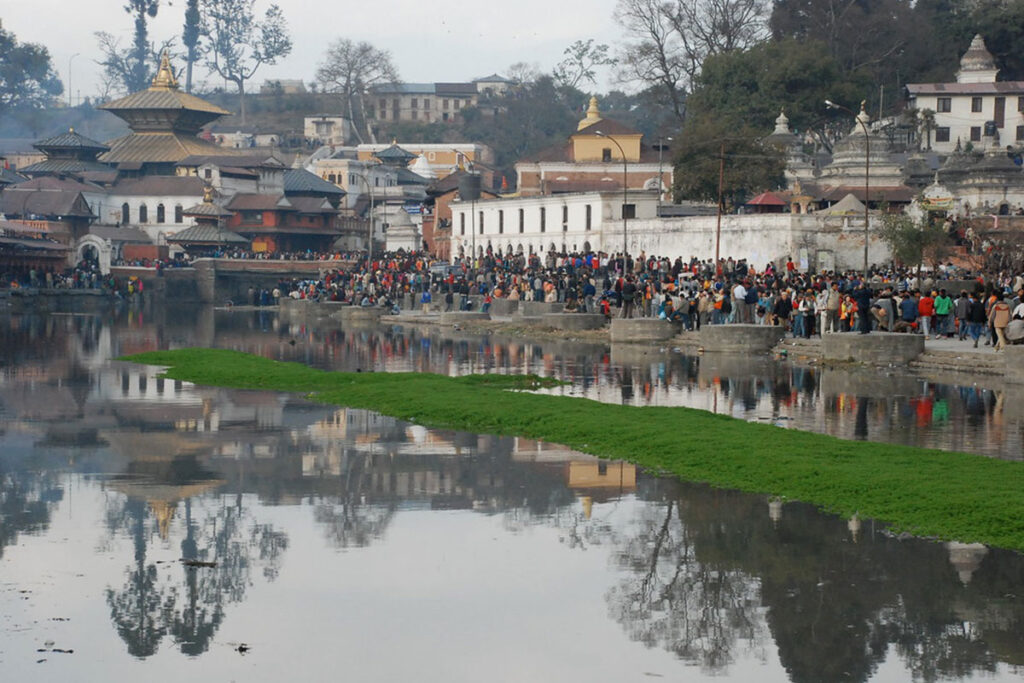
Kathmandu Heritage Multi Day Tours & Hikes
Kathmandu Valley | Heritage Treks & Tours – Nepal
Kathmandu | Full Day World Heritage Sightseeing Tour | Boudhanath, Pashupatinath & Swayambunath
Kathmandu is filled with World Heritage sites and sacred destinations, crowded with traditional neighborhoods and colorful festivals. Spend a few days exploring Nepal’s exotic capital and the history-laden Kathmandu valley. We can arrange sightseeing guide, vehicles and guides as required. See Kathmandu Heritage + Happenings for more details.
We recommend beginning with Pashupatinath in the early morning, and moving on to Boudhanath mid-morning. Hindu Pashupatinath on the sacred Bagmati river and its sacred temple complex is one of Nepal’s most important sites, a powerful cremation site and Nepal’s most important Hindu temple. Here, monkeys run up and down the steps of the burning ghats, and trident-bearing saddhus draped in burnt-orange and saffron sit serenely meditating, when they’re not posing for photos-for-rupees. Local guides can explain the significance of the complicated ceremonies. Please be respectful when taking photos.
Boudhanath, in the midst of traditional monasteries (gompas) and hung with long strings of multi-colored prayer flags, attracts Sherpas, Tibetans and tourists alike for daily circumambulations (koras) of the iconic stupa. The striking Buddha eyes of Boudhanath Stupa watch over a lively and colorful Tibetan community and attract pilgrims from all over the Himalayan Buddhist realm. There are wonderful spots for lunch at Boudhanath (Roadhouse Cafe has wood-oven pizzas and a breathtaking view of the stupa and colorful Nepals circling it), and it’s a good place to learn the technique of thanka painting and purchase a thanka (Buddhist mural). See also Bhaktapur for more options for shopping for thankas.
Wander through the many temples, pagodas, courtyards and the museum at Kathmandu Durbar Square, a timeless gathering spot and a UNESCO World Heritage site. Kathmandu Durbar Square, including the old royal palace, is Kathmandu’s ‘Palace Square’, a showcase for the world renown artisans and craftsmen of Kathmandu and a synthesis of Hindu and Buddhist palaces, temples, stupas and statues. The Malla and Shah kings ruled over the Kathmandu Valley during the centuries of the building of the layers of this Durbar Square. Along with their opulent palaces, the square surrounds numerous courtyards and temples, all works of art with intricate and often erotic carvings. Kathmandu Durbar Square is known as Hanuman Dhoka Durbar Square, a name derived from a statue of Hanuman, the monkey devotee of Lord Ram, at the entrance of the palace. The social, religious and urban focal point of the city, Durbar Square is often the site of festivals, marriages and other ceremonies such as Teej. Some important structures are Hanuman Dhoka Palace, Kumari Ghar (Abode of the Living Goddess), Taleju Temple, built between the 12th and 18th centuries, the 17th century stone inscription set into the wall of the palace with writings in 15 languages.
In the evening (take the interesting back streets from Durbar Square) climb the many steps to the gilded Swayambhunath stupa (known as the monkey temple) which rises from the Kathmandu valley floor at 1420 meters and is one of the holiest Buddhist sites in Nepal. Swayambunath, the ‘self created’ stupa, was founded over 2000 years ago at a time when the Kathmandu valley was filled by a large lake, with a single lotus in the center. Mythology says that Manjusri, a bodhisvatti, drained the lake with one cut of his sword and the lotus flower was transformed into the stupa. From its commanding views of Kathmandu, circumambulate Swayambunath’s white-washed stupa, painted with distinctive Buddha eyes, the complex a unique synthesis of Buddhism and Hinduism. Another interesting time to visit Swayambunath is in the mornings, when Nepalis visit the temple dedicated to the God of Smallpox to with colorful offerings for the goddess.
Stop to photograph reflections in Kathmandu’s many pokhari’s, or ponds, including the beautiful Rani Pokhari (queen’s bath) near New Road, and the Naga Pokhari (pond of the snake gods of the underworld) just beyond the palace gates. The many bathing ghats, square enclosures with steps leading down to water spouts, often decorated with naga heads, are also interesting and colorful gathering spots.
+Entrance Fees not Included for Single Person
Kathmandu | Half Day World Heritage Patan Durbar Square Sightseeing Tour
Visit the third of Kathmandu’s ancient capitals, known as ‘The City of Fine Arts’, best if you have an extra day in hand as Patan is also rich in cultural heritage, has many lovely roof-top cafes for lunch and world-class museums. Some of the highlights of Patan are its Durbar Square, the Krishna Temple within the palace complex of Patan (entirely made of stone, with 21 distinctive spires), and Hiranya Varna Mahavir, or the Golden Buddha Temple.
+ Entrance Fees not Included for Single Person
Kathmandu Valley | Full Day World Heritage Bhaktapur & Changu Narayan Sightseeing Tour
One more day in Kathmandu, with a sightseeing excursion by private vehicle to Bhaktapur. Bhaktapur which translates as ‘Place of Devotees’ and is also known as Bhadgaon, is an ancient Newar city approximately 15 kilometers east of the Kathmandu Valley. Bhaktapur is one of three ancient capitals of the Kathmandu valley, the capital of the Newar Kingdom and a city of artisans and craftspeople famous for its art and architecture: intricate carvings, sculptures, paintings, thankas, pottery, statues and temples, or pagodas. Bhaktapur has a well-preserved ‘durbar square’, or palace square, and has been named a World Heritage site by UNESCO because of its incredible temples, pagodas, wood carvings, stone carvings and metalwork. Bhaktapur is also famous for its yogurt, called curd in Asia, a taste which hasn’t been duplicated anywhere.
Spend the day exploring Bhaktapur and its rich cultural heritage, where a majority of enthnic Newaris live in traditional ways, and life seems to stand still. There are many great restaurants and cafes to rejuvenate, and it’s possibly the best spot in Kathmandu for purchasing a thanka after watching the technique, as well as shopping for endless other locally produced crafts. Bhaktapur is home to countless local festivals, so if you are lucky and arrive on a festival day, enjoy the timeless and colorful events unfold.
You’ll also visit at Changu Narayan, a few km from Bhaktapur and one of Kathmandu’s oldest Newari temple villages. Legend has it that Changu Narayan was given to the daughter, Champak, of a Kashmiri king of Nepal when she wedded the prince of Bhaktapur. The important Vishnu temple is one of the oldest temples in all of Nepal, and was damaged during the 2015 earthquakes.
+ Entrance Fees not Included for Single Person
Everest Sightseeing Mountain Flight
An hour long extravaganza of the world’s 8000 meter peaks. Airport Transfers not Included. (+$250 or Market Price)
Everest Sightseeing Helicopter Tour
Inquire for prices and options for a once in a lifetime helicopter trip flying right over Everest Base Camp, Kala Pattar, the Khumbu Glacier, plus incredible views of Everest, Lhotse, Nuptse, Cho Oyu, Makalu, Ama Dablam, Pumori and more! Cost per helicopter, option to stop at Everest View Hotel for an ‘Everest breakfast’. (+$Inquire for Options)
Cycling Trip Kathmandu Valley
Many options for day trips, or extended trips, in the Kathmandu Valley. We can customize a cycling trip for you in partnership with one of our knowledgeable partners in Kathmandu. (+$Inquire for Options)
Shivapuri Heights Cottages
A wonderful get away 20 km north of Kathmandu, Shivapuri Heights Cottages are stylishly designed and personal cottages built around a ‘common house’, where you can breakfast overlooking the stunningly beautiful Kathmandu valley. Massages available on request. (+$Inquire for Options)
Extra Days in Kathmandu | Customize your Journey!
We have plenty of great suggestions for extra days, or weeks, in Nepal! See our Nepal & Kathmandu Modules | Customize Your Trip! for ideas to put together the perfect journey.
We recommend Kathmandu Valley heritage tours to Bhaktapur or Patan (the Kathmandu Valley’s other historic capital cities), mountain biking, river rafting, yoga retreats, get-aways to Gorkha, Bandipur, Panauti or Namo Buddha to visit traditional hill villages, temples, monasteries and fortresses or a tour of the Newari temple of Changu Narayan and a night at the Fort Hotel in Nagarkot for sublime Himalayan panoramas!
Everest sightseeing flight or an epic helicopter tour over Everest Base Camp, a luxurious stay at Temple Tree Resort & Spa in Pokhara or Himalayan Front in Sarangkot, paragliding, hiking or zip-lining over Phewa Lake, a spa + wellness getaway at Dwarikas Resort in Dhulikhel, a relaxing, luxury wildlife excursion to Chitwan National Park staying at Tharu Lodge or Maruni Sanctuary Lodge, a chic wildlife safari in Bardia National Park at Tiger Tops, a weekend of adventure, sauna and pampering at The Last Resort or 5-star treatment in historic Dwarika’s Heritage Hotel in Kathmandu.
Kamzang Journeys can customize any of these wonderful excursions for you!
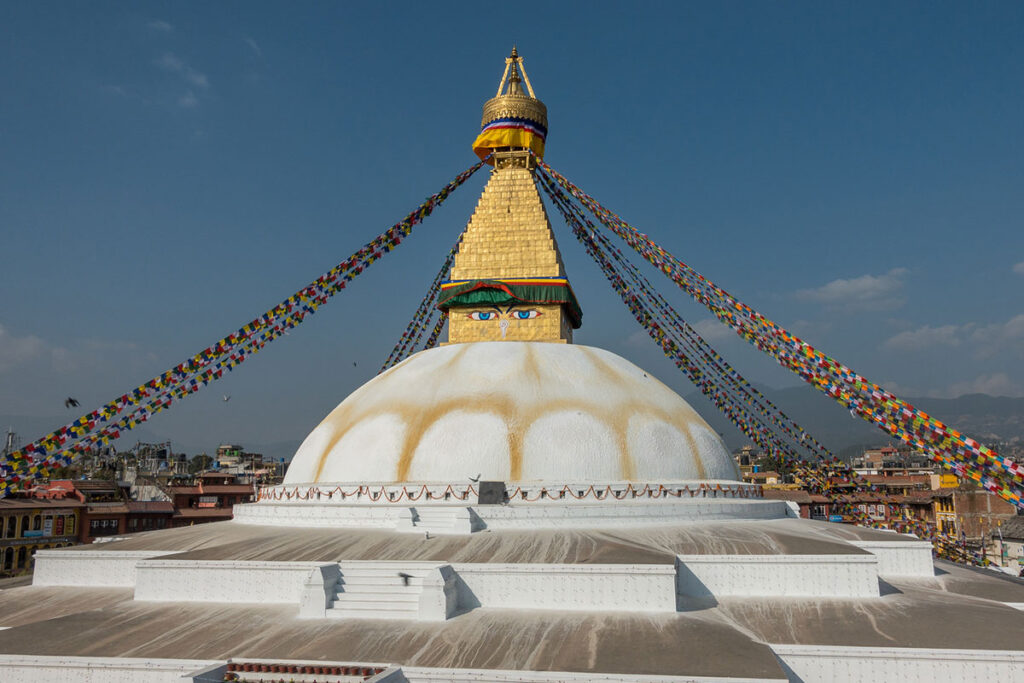
Everest Heli Tours
Everest Helicopter Tour Kwondge | Dinner Sunset & Sunrise over Everest – Yeti Mountain Home
An epic private helicopter tour for an extra day in the spectacular Khumbu region. Sunset dinner and sunrise breakfast overlooking some of the best Himalayan views on the planet! Board your private helicopter from Namche for the quick flight to Kwongde YMH Lodge, and enjoy lunch overlooking this vast panorama of peaks. Views include some of the highest peaks on the planet, including Everest, Lhotse, Makalu, Cho Oyu, Gyajung Khang (the highest peak under 8000m), and the majestic Ama Dambam. From the YMH Lodge, you can look down on Kwonde Lake, generally hidden, and up the awe-inspiring Khumbu valley. The Kwongde YMH (Yeti Mountain Home) is a luxury lodge, one of the world’s highest hotels in one of the Himalaya’s most dramatic locations. Your epic helicopter tour finishes back in Namche Bazaar, but you have the option to charter the helicopter back to Lukla or Kathmandu.
+ Price Per Helicopter – Namche to Namche ($1800)
+ Max 4 Passengers
+ Price Per Person Yeti Mountain Home – Breakfast + Dinner ($175)
+ Single Supplement ($75)
Everest Mountain Helicopter Sightseeing Tour | Namche to Namche | Lukla, Everest Base Camp, Cho La Pass (Gokyo Valley), Renjo La Pass (Thame Valley) & Namche
A once in a lifetime helicopter tour of the Everest region’s spectacular peaks, glaciers, and Himalayan passes! Your private helicopter picks you up in Namche Bazaar, from where you will fly over the Khumbu Glacier and to Everest Base Camp, as well as the incredible Everest icefall. You will have a chance to stop on Kala Pattar for photos of this spectacular setting. Back in your helicopter, your flight path takes you over Dzongla Lake, the glaciated Cho La pass, and into the stunningly beautiful Gokyo valley, flying low over the turquoise Gokyo Lake, with another touch down to splash some sacred lake on yourself before crossing the Renjo La pass to the traditional Thame valley, the old trade route to Tibet. Your epic helicopter tour finishes back in Namche Bazaar, but you have the option to charter the helicopter back to Lukla or Kathmandu.
+ Price Per Helicopter ($2750) – Namche to Namche
+ Max 4 Passengers
Everest Mountain Epic Sightseeing Tour | Kathmandu to Kathmandu | Lukla, Everest Base Camp, Cho La Pass (Gokyo Valley) & Namche
The full helicopter deal, all the way from Kathmandu to Everest Base Camp, and much more! A once in a lifetime helicopter tour of the Everest region’s spectacular peaks, glaciers, and Himalayan passes! Your private helicopter picks you up at Tribhuvan Airport in Kathmandu, from where you will fly up to the fabled Tenzin Norgay airport in Lukla. After a cup of tea in Lukla, you will reboard your helicopter and fly over the Khumbu Glacier and to Everest Base Camp and the sublime Everest icefall. You will have the unique chance to stop at Everest Base camp for photos of this spectacular setting.
Back in the helicopters, your flight path takes you over beautiful Dzongla Lake, the glaciated Cho La pass, and into the stunningly beautiful Gokyo valley, flying low over the turquoise Gokyo Lake and down the Gokyo Valley. Your epic helicopter continues by flying back over Namche Bazaar, and back through Nepal’s lush middle hills to Kathmandu.
+ Price Per Helicopter ($5000) – Kathmandu to Kathmandu
+ Max 4 Passengers
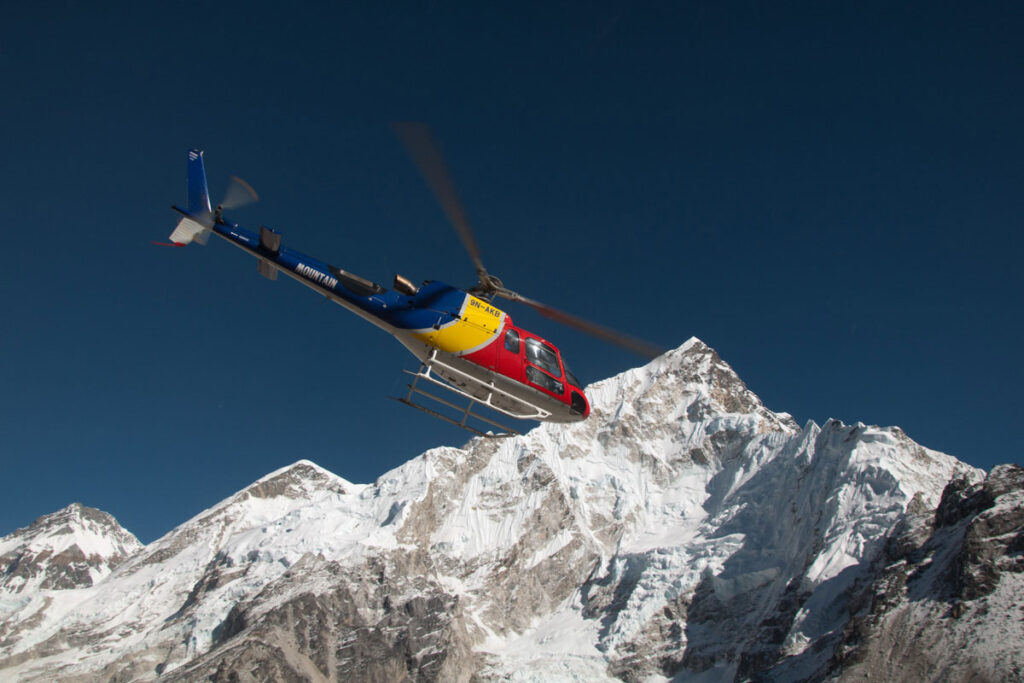
Great Stays
BOUTIQUE & LUXURY HOTELS | KATHMANDU VALLEY
Kathmandu Guest House
Kathmandu Guest House
The Kathmandu Guest House is one of Kathmandu’s first hotels, originally a Rana Palace. Located in the heart of Thamel, the Kathmandu Guest House is a beautiful, lively hotel with a large garden and lovely outdoor cafes, centrally located in Thamel with a wide range of restaurants, cafes, yoga and shopping surrounding it. KGH offers a wide selection of rooms, including their wonderful deluxe rooms.
“Travelers know that the frenetic pace of a crowded city like Kathmandu needs an escape. The Kathmandu Guest House, a converted Rana dynasty mansion with fragrant gardens and airy corridors, has provided the peaceful refuge of choice since 1967. Since the days of being the first and only hotel in Thamel, the packed tourist district of Kathmandu, it’s become something of an institution. It’s close to everywhere and its gate is the meeting point that nobody can mistake. As a guidebook put it, “Kathmandu Guest House acts as a magnet for mountaineers, pop stars, actors and eccentric characters.” Even the Beatles stayed here in 1968. Whether you’re returning from the mountains or arriving from the airport, come and relax at the courtyard restaurant, order a cup of fine Italian coffee or a chilled Gorkha Beer, and escape for a moment in the historic surroundings of Kathmandu’s most loved guesthouse.”
Kathmandu Guest House Timeline
KGH History
Dwarika’s
Dwarika’s Hotel
Dwarika’s, Kathmandu’s premier hotel built and decorated with traditional Kathmandu valley architecture, is an oasis of calm located near the airport, where you can relax by the pool, visit the award-winning spa, enjoy the serene, historic surroundings and dine at one of their world-class restaurants.
“Dwarika’s Hotel was registered in 1977, with the idea of reviving the architectural splendour of the valley. All the terracotta work was made in the valley, using local clay and skills. The couple also incorporated elements of Nepal’s diverse cultural heritage, including those from beyond the valley, when designing the rooms. The furniture was crafted by families of traditional carpenters, and the linen, textiles and embroideries were hand woven and used Nepali patterns. In all purposes, Dwarika Das Shrestha took some of the finest elements of Nepali crafts, and presented them in a way that had not been done before. In explaining his vision, he once stated: “My project is to recreate a 15th-17th century environment where tourist and Nepali alike would have a sensation of the original. The hotel as a commercial enterprise is merely a vehicle to finance and carry my dream forward.”
History of Newari Culture in Kathmandu. Inspiration for the Heritage Architecture of Dwarika’s
Newari History in Kathmandu
History of Dwarika’s
Dwarika’s History
Dwarika’s Resort Dhulikhel
Dwarika’s Resort
A top-notch resort, with a wonderful spa, and wellness, and yoga retreats, on the Kathmandu Valley rim. “With the belief in the need for maintaining harmony between the body, mind, spirit and the planet for a peaceful, healthy and balanced life; the Dwarika’s Resort is built on the philosophy of respecting nature and self. The resort takes its inspiration from ancient Hindu Vedic scriptures (Vedas), Buddhist medicine and traditional Himalayan knowledge. The Himalayan belt has been home to holistic healing and wellbeing for more than three thousand years. The region’s approach to wellbeing, its serene natural beauty and rare medicinal herbs has attracted great sages through time. The Hindu Vedic scriptures describe Ayurveda, the science of life, as a comprehensive approach to wellbeing that encompasses the study of biology, spirituality, psychology, astronomy, nutrition and beauty. Originating from the same roots the Buddhist approaches to wellbeing also follows similar path and views health as harmony between the mind, body, spirit and one’s environment.
The resort has been designed based on the knowledge of these ancient understanding about holistic wellbeing with all the spaces being consecrated and brought to life. The lifestyle spaces within the resort are designed to attract positive energy and keep negative energy at bay. When you go around the resort you can find details we have placed in various spaces to ensure the energy within the resort is as positive as possible. For example, the resort is surrounded by Cactus (Ketuki), which is believed to cleanse the space around it of all the negative energy and attract positive energy instead. Hence, adding to the calm and nurturing environment offered within the resort. The resort also offers various activities within these spaces to enhance and add value to our guests’ experience.”
Yak & Yeti
Yak & Yeti
Yak & Yeti is one of Kathmandu’s historic 5-star hotels, steeped in history, with a lovely pool and garden, located just off Durbar Marg, a tree-lined, upscale road of shops and hotels. ” Yak & Yeti opened in 1977 as a 120 room, 5-star hotel – the first of its kind in Nepal. A new wing of an additional 150 rooms was built in harmony with the architectural features of the old palace, Lal Durbar, bringing the room total to 270. The whole hotel is a sumptuous array of beautiful artifacts, art, and traditionally crafted fixtures. Attention to detail has been meticulously considered throughout, giving the feeling you aren’t just in a hotel as much as an art gallery or museum. Over the years the hotel has been upgraded and extended and now boasts a shopping arcade, a swimming pool, two tennis courts and a state-of-the-art fitness center and luxury spa.”
Hyatt Regency
Hyatt Regency
The Hyatt is a stylish, 5-star hotel located near Boudhanath, with a large pool, a great buffet breakfast, a gym and a mix of Buddhist and Hindu decor in the lobby and rooms. “Hyatt Regency Kathmandu is a five-star luxury hotel and resort in Kathmandu, set on 37 acres of landscaped grounds and created in the traditional Newari style of Nepalese architecture. This beautiful hotel and resort is located on the road to the Boudhanath Stupa: the most holy of all Tibetan Buddhist shrines outside of Tibet and a UNESCO World Heritage Site located within a five-minute walk from the hotel. The hotel is just 4km (2.4m) from the Tribhuvan International Airport and 6 km (3.7m) from the city center of Kathmandu.”
Hotel Tibet
Hotel Tibet
“Since 1998, Hotel Tibet has set the standard for showcasing the warmth of Tibetan hospitality. Newly renovated post-COVID, we have worked towards merging modern elements with traditional Tibetan aesthetic to provide you with the utmost convenience and comfort and to make your stay with us a memorable experience. We have newly-renovated rooms, divided into deluxe, club, and suite categories that combine contemporary and traditional Tibetan designs. Our rooms are especially designed with your comfort in mind, featuring plush bedding, modern furnishings, and elegant decor.”
Dusit Princess
Dusit Princess
Kathmandu’s BEST rooftop bar, restaurant and pool. Brother of the owner of Hotel Tibet, which shares the property. “Make Dusit Princess Kathmandu your base for exploring Nepal’s vibrant capital. Comfort, value and convenience will define your stay, with warm Thai and Nepalese hospitality woven into every moment. Conveniently located in upmarket Lazimpat, the hotel has international restaurants and Narayanhiti Palace Museum on its doorstep.”
Marriott
Marriott
The Marriot was completed in 2020, located just near Nag Pokhari, with Kathmandu’s best buffet! “Retreat to Kathmandu Marriott Hotel, a 214-room contemporary hotel in the capital city of Kathmandu. Settle into spacious, well-appointed rooms and suites, many with views of the Himalayan range. Dine in our hotel restaurants, featuring International cuisine at Thamel Kitchen and Asian cuisine at Edamame. Relax at Raksi Music Bar with delicious food and beverages overlooking our waterfall terrace. Get pampered in our full-service hotel spa and salon, take a dip in our outdoor pool or work out in our 24-hour fitness center.”
Sheraton Hotel
Sheraton Hotel
One of Kathmandu’s great rooftop bars and pools! “Surrounded by the Himalayas, The Sheraton Kathmandu Hotel is conveniently located along the city’s main road, Kantipath. Once the Royal Palace for the kings of Nepal, The Narayanhiti Palace Museum is nearby as are embassies, banks and corporate offices. Tribhuvan International Airport is forty minutes away.
Kathmandu’s most popular tourist area, Thamel is located adjacent to the hotel and is filled with restaurants, bars, cafés and shops. In addition to traditional woolen items, pashmina shawls and scarves, as well as mountaineering equipment, you can savor some delightful Nepalese cuisine, including dumplings called momos, dal, and kwati, a delicious Newari curry soup made with a variety of beans.
This 20,000 SM GFA, 218-key Sheraton Hotel is located on a 6,647 SM site in the center of Kathmandu. The hotel includes food and beverage, a 900 SM banquet hall, meeting rooms, spa and gymnasium facilities and back-of-house areas.”
The Terraces
The Terraces
“The Terraces Resort and Spa is a luxury resort in Nepal, offering stunning views of the Kathmandu Valley and majestic Himalayas located near the border of Bhaktapur with easy access from Lalitpur. We provide the perfect environment to unwind, reconnect with nature and celebrate life’s special moments. Our friendly and professional staff is dedicated to catering to your every need, guiding you to discover the best of Nepal’s culture and nature through bespoke activities and tours. Immerse yourself in the historical sites of Bhaktapur or venture into the scenic landscapes of Lakuri Bhanjyang, creating unforgettable experiences that embrace the essence of Nepal. The Terraces is not just a luxury resort in Kathmandu – it is a destination where you can savor life to the fullest.
The resort, located just 16km from Kathmandu’s Tribhuvan International Airport, fuses international sensibilities with the best of what Nepal has to offer: Stunning mountain views, fresh air, wide open spaces and organic food. Each spacious room or suite comes with a terrace balcony. The only barrier between you and the beautiful world outside is floor-to-ceiling windows.”
BOUTIQUE HOTELS
There are many other boutique and character-filled hotels and guesthouses around the Kathmandu Valley. Just a few that we like listed, but this is not AT ALL an extensive list.
KATHMANDU | THREE CAPITALS
Potala Guesthouse – Thamel
Hotel Roadhouse – Thamel
Kantipur Temple House – Thamel
Nepali Ghar – Thamel
Aloft by Marriot – Thamel
Hotel Mulberry – Thamel (Pool)
1905 Suites – Nag Pokhari
Hotel Manaslu – Lazimpat
Hotel Shambala – Bainsbari – Maharajganj (Pool)
Babar Mahal Vilas – Babar Mahal
Hotel Padma – Boudhanath
Rokpa Guest House – Boudhanath
Hotel Shambaling – Boudhanath
Hotel Tibet International – Boudhanath
Hotel Lotus Gems – Boudhanath (Pool)
Cozy Nepal – Patan
Pahan Chhen – Patan
Traditional Stay Patan – Patan
The Inn Patan – Patan
Traditional Homes | Swota – Patan
Peacock Guest House – Bhaktapur
Hotel Heritage – Bhaktapur
KATHMANDU VALLEY & AROUND
The Fort Resort – Nagarkot
Hotel Mystic Mountain – Nagarkot
Gaia Holiday Home – Dhulikhel
Gokarna Forest Resort – Gokarna
Shivapuri Heights Cottages – Budhanilkanta, Shivapuri
The Old Inn – Bandipur
The Famous Farm – Nuwakot
Gorkha Gaun Resort – Gorkha
Terraces Resort – Lhakuri Bhanjyang Lamatar
Balthali Village Resort – Panauti
Park Village Resort – Budhanilkhanta (Pool)
POKHARA & AROUND
Begnas Lake Resort – Begnas Lake (Pool)
Hotel Karuna – Pokhara
Temple Tree Hotel & Spa – Pokhara (Pool)
Lakeview Resort – Pokhara
Hotel Barahi – Pokhara (Pool)
Summit River Lodge – Kurintar (Kathmandu – Pokhara Highway)
Ghale Gaun Homestay – Ghale Gaun (Near Besi Sahar)
FARMHOUSES & HOMESTAYS
Namo Buddha Resort – Namo Buddha
Herb Nepal – Bhaktapur
Nagarkot Farmhouse – Nagarkot
Srijana Farms – Tansen, Palpa
The Bosan Farmhouse – Bosan Danda
Almost Heaven Farm – Ilam
Barpeepal Bisauni Homestay – Ilam
KATHMANDU POOLS
Hyatt Regency – Boudhanath
Dwarika’s Hotel – Near Airport
Park Village Resort – Budhanilkhanta
Hotel Shanker – Lazimpat
Hotel Shambala – Bainsbari – Maharajganj
Marriott – Nag Pokhari
Yak & Yeti – Durbar Marg
Hotel Mulberry – Thamel
Photos
KIM BANNISTER PHOTOGRAPHY | HIMALAYAN TREKS, CYCLE TRIPS & TRAVELS
Kim Bannister Photography
CYCLE THE HIMALAYA PHOTOS
Guided Cycling Trips
KAMZANG JOURNEYS | ALL ABOUT US IN PHOTOS
Explore Kamzang Journeys
KAMZANG JOURNEYS | YELLOW TENT PHOTOS
The Yellow Tent of Eternal Happiness
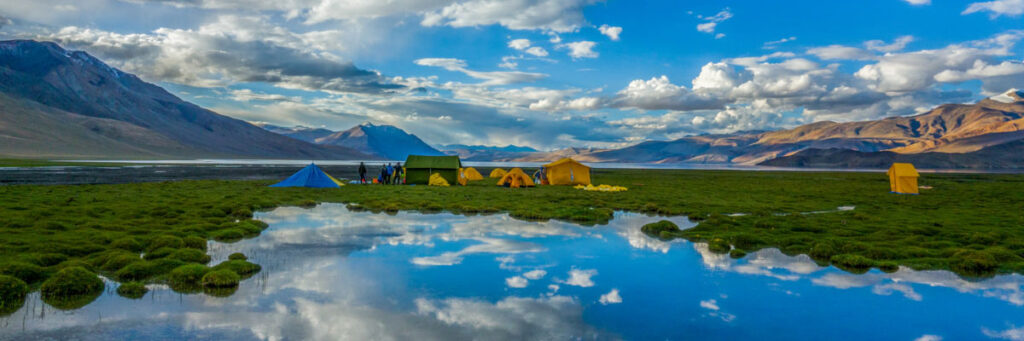
HIMALAYAN WILDLIFE, BIRDS & FLOWERS PHOTOS
Himalayan Wildlife, Birds & Plants
HIMALAYAN DESIGN & CULTURAL PHOTOS
Himalayan Design & Cultural Photos
KAMZANG JOURNEYS GROUP PHOTOS
Kamzang Journeys Groups
KAMZANG JOURNEYS STAFF PHOTOS
Kamzang Journeys Staff
THE KAMZANG FUND & KAMZANG KIDS PHOTOS
The Kamzang Fund
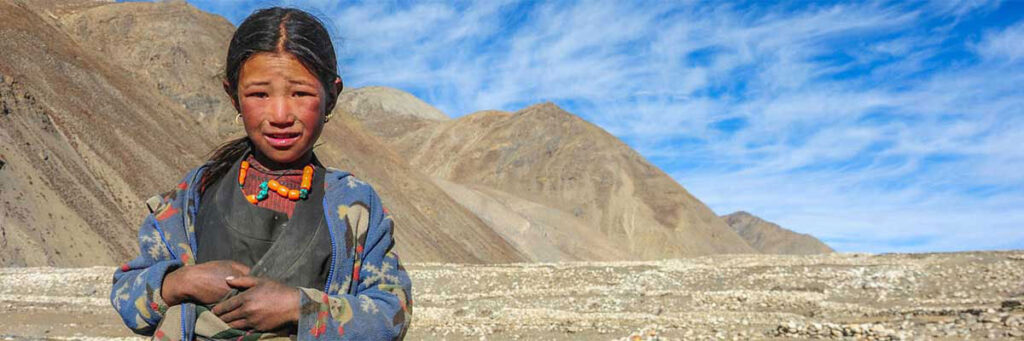
NEPAL JOURNEYS PHOTOS
Nepal Journey
INDIA JOURNEY PHOTOS
India Journeys
TIBET JOURNEYS PHOTOS
Tibet Journeys
BHUTAN JOURNEYS PHOTOS
Bhutan Journeys
MYANMAR (BURMA) JOURNEYS PHOTOS
Myanmar (Burma) Photos
MONGOLIA JOURNEYS PHOTOS
Mongolia Journeys
SOUTHEAST ASIA PHOTOS
South East Asia Photos